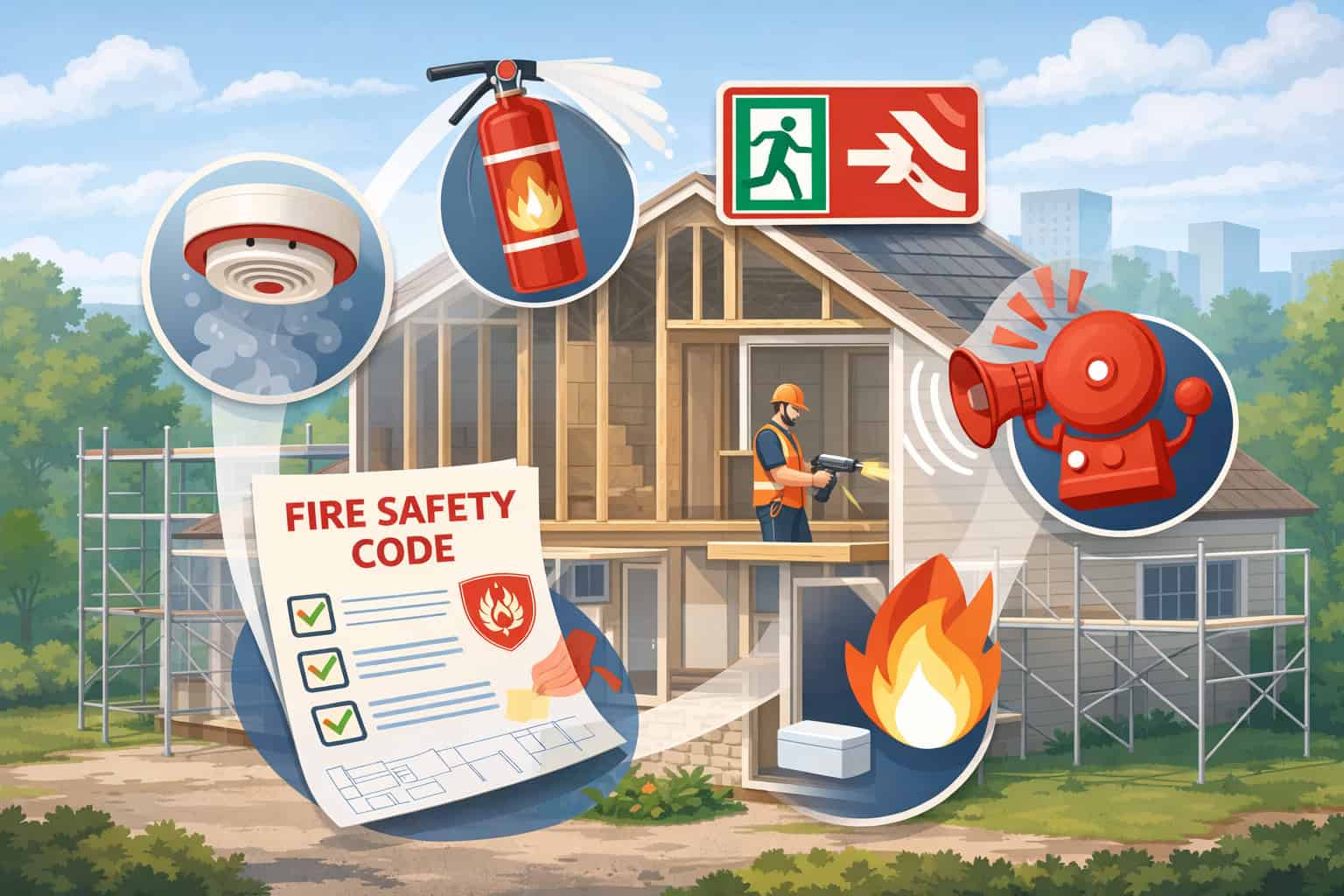
Homeowners often think about fire safety at the end of a project, when the final inspection is approaching and the punch list is almost done.
In reality, fire safety regulations Delaware homes must be part of renovation planning from the beginning, because layout changes, added bedrooms, finished basements, electrical upgrades, new fuel-fired equipment, and garage conversions can all affect life-safety requirements long before the last coat of paint goes on.
Delaware’s statewide fire-prevention framework, county and municipal building enforcement, and local permit review processes all shape how a renovation is approved and what corrections may be required before closeout.
For homeowners, landlords, property investors, and contractors, that means fire code issues are not just a bureaucratic hurdle. They affect where alarms go, whether a new bedroom is legal, whether a basement can be safely used as living space, how garage walls are finished, how wiring is upgraded, and whether concealed cavities are properly blocked to slow flame spread.
Delaware law requires smoke detection in residential occupancies, and current county renovation guidance shows that additions, repairs, basement finishing, and room creation can trigger alarm, egress, and related life-safety review.
In practical terms, home renovation fire safety Delaware projects are about giving people time to escape, limiting how quickly fire and smoke can spread, and making sure the finished home is safer than it was before the work started.
The exact requirements can vary based on the municipality, the permit scope, the age of the house, whether the home is owner-occupied or rented, and which systems are being altered. That is why every project should be verified with the local building department, fire official, and licensed trades involved before work begins.
What fire safety regulations mean during a residential renovation
When people hear “fire code,” they often picture commercial buildings, exit signs, or sprinkler systems. In a home renovation, the concept is broader and more practical.
Fire safety regulations for residential work are the set of rules that govern early warning, safe escape, protection of hidden building cavities, safe electrical and mechanical work, and separation between fire-prone spaces and living areas.
That is why Delaware fire code renovation requirements often show up in ordinary home projects. A finished basement may need emergency escape and rescue openings. A new sleeping room may require specific alarm coverage.
A garage conversion may raise questions about wall and ceiling separation, penetrations, and room use. A kitchen remodel may seem cosmetic, but moving appliances, adding circuits, or changing ventilation can create fire safety review issues.
County permit offices and plan review materials in Delaware make clear that remodeling, additions, and alterations can trigger code review rather than being treated as purely decorative work.
This is also why Delaware residential fire safety laws should be understood as a layered system. State law and State Fire Prevention Regulations establish the broader framework, while counties and municipalities handle permitting, inspections, and local code enforcement. In some places, county review is primary.
In others, an incorporated town may have its own building code administration. That means two similar projects in different locations can move through different review paths and inspection schedules.
A homeowner-friendly way to think about it is this: fire regulations are less about punishing renovation work and more about asking a few core safety questions.
Can occupants be warned quickly? Can they get out? Can emergency responders get in if needed? Are ignition risks reduced? Will hidden spaces help a fire spread faster? Is the new use of the room safer than before?
For broader preconstruction planning, readers often benefit from reviewing permit and rules guidance before renovating and a step-by-step renovation planning guide early in the process.
Why remodeling projects trigger fire safety review more often than people expect
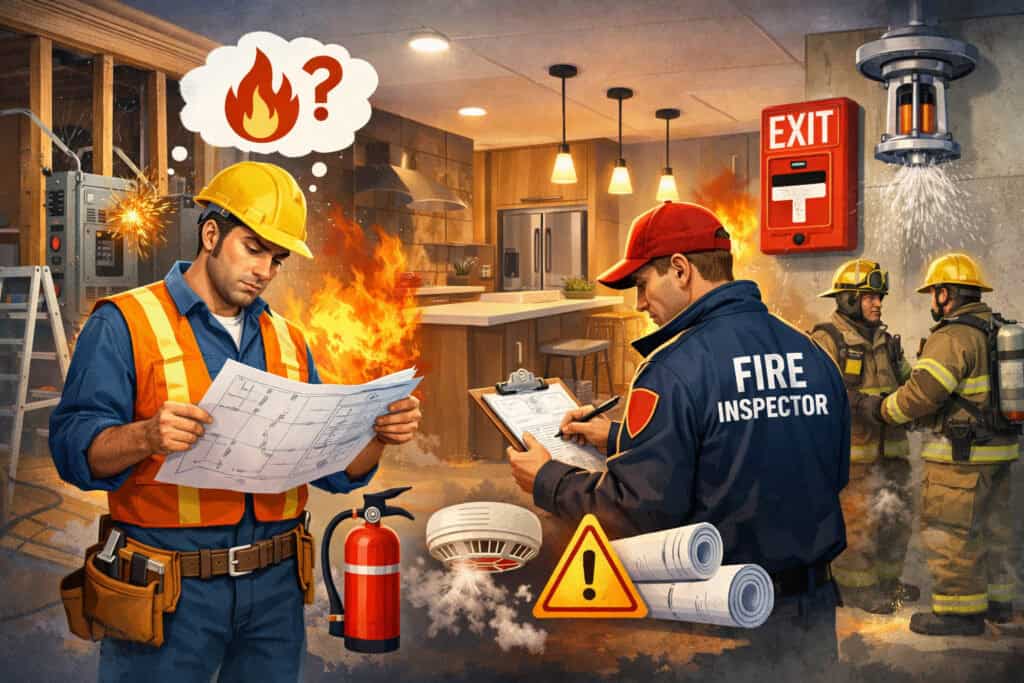
Many renovation disputes start with a simple assumption: “We’re not building a new house, so the fire rules should not really apply.”
That assumption causes delays. In practice, fire safety rules home remodeling Delaware projects can be triggered by room additions, permit-required alterations, creation of sleeping rooms, basement finishing, opening walls, panel upgrades, HVAC replacement, and fuel-fired equipment changes.
New Castle County’s current smoke-alarm policy specifically states that alterations, repairs, and additions requiring a permit, or projects that add or create one or more sleeping rooms, require smoke alarms in the locations required for new dwellings, while certain exterior-only, plumbing-only, or non-fuel-fired mechanical work does not invoke the same alarm requirements.
That distinction matters because project scope often evolves. A “simple basement refresh” can become a finished recreation room with a bedroom. A kitchen remodel can become a full rewire of countertop circuits, lighting, and exhaust.
An attic cleanup can become a habitable room. The moment the project affects occupancy, sleeping arrangements, or major systems, fire code compliance Delaware construction review becomes much more likely.
County basement guidance in both New Castle and Kent points in that direction by requiring emergency escape and rescue planning, alarm locations, and fire-blocking details for finished basement projects.
Another reason renovations trigger fire review is that existing homes do not always match current expectations for life safety. Older homes may have too few alarms, outdated wiring methods, open wall cavities, poor separation near attached garages, or basement spaces that people use informally without code-compliant escape.
Once those spaces are being renovated under permit, local reviewers may require safer conditions as part of approval. That does not mean every older house must be rebuilt to new-house standards in every respect.
It does mean that once you touch certain areas, the work may need to bring specific life-safety features up to current requirements for the permitted scope.
Renovations that most commonly raise fire code questions
Some project types are more likely than others to create fire safety questions. Basement finishing is one of the biggest examples because it combines alarms, egress, concealed framing, heating, and often bedroom creation.
Kitchen remodels are another because modern appliance loads, exhaust equipment, and circuit requirements can expose older electrical limitations.
Additions and attic conversions may trigger new alarm locations and safe exit review, especially if they add sleeping areas. Garage work can affect separation, utility placement, and carbon monoxide protection when the garage communicates with the house.
Even projects that appear cosmetic can drift into fire-safety territory. Replacing finishes alone may not trigger much review, but once walls are opened, wiring extended, new fixtures installed, or space usage changed, life-safety questions follow quickly.
Homeowners also run into trouble when they build in stages without recognizing how inspectors see the final use of the room rather than the homeowner’s informal label for it. A room furnished and wired like a bedroom is likely to be reviewed like one.
Pro Tip: Before demo begins, write down the intended use of every renovated room. “Office,” “playroom,” “sleeping room,” and “finished basement” can lead to different review expectations.
Why the same project can be treated differently by location
Delaware homeowners should expect variation by jurisdiction. State fire regulations apply broadly, but county and municipal building departments control permits, inspections, adopted code administration, and submittal procedures in their areas.
New Castle County provides online permit and inspection tools, Kent County publishes permit guidance for specific residential scopes, and Sussex County states that its building code office handles plan review and inspections for new construction, additions, remodeling, and alterations in unincorporated areas and participating towns.
That matters because one jurisdiction may have a published policy handout for smoke alarms or basement finishing, while another may handle similar issues through plan review comments. Some towns inside county boundaries also administer their own codes.
So while the safety principles are similar, the paperwork, reviewer comments, and inspection sequence can differ. This is one reason Delaware building fire safety regulations should always be verified for the specific property address rather than assumed from a project done elsewhere.
Smoke alarms and carbon monoxide alarms in Delaware renovation work
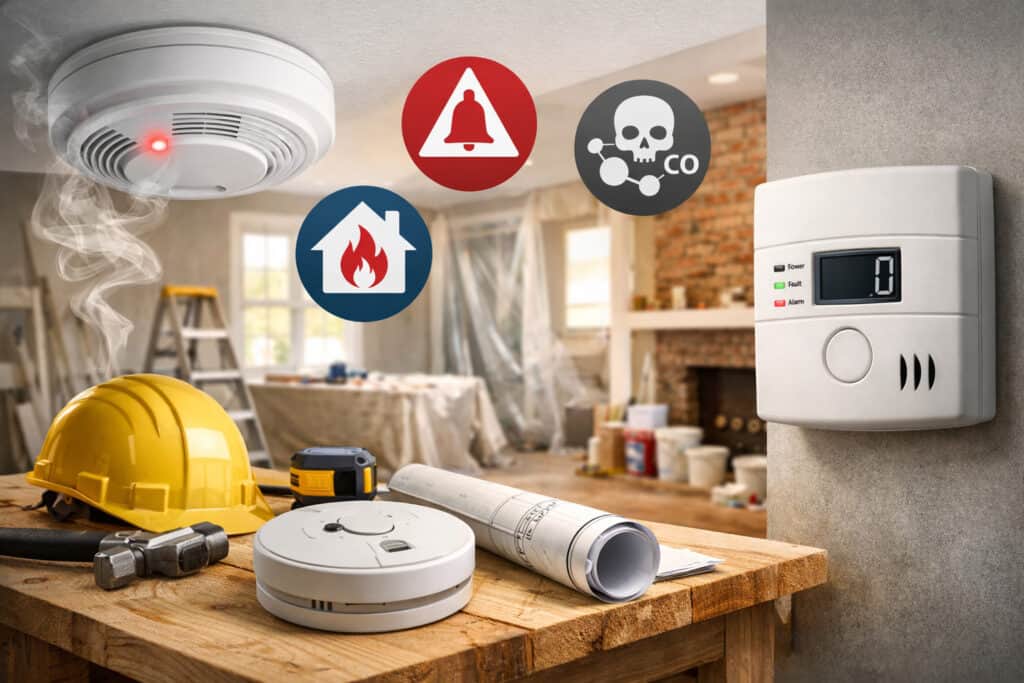
Alarm upgrades are one of the most common and most misunderstood parts of fire safety regulations in Delaware homes. Delaware’s State Fire Marshal explains that smoke detectors are required on each level of all one- and two-family dwellings, mobile homes, modular homes, and townhouses, and also outside each bedroom or group of bedrooms.
The same state guidance notes that homes built before July 8, 1993 are generally required to have battery-powered single-station smoke detectors, while homes constructed after that date are required to have hard-wired detectors installed by a licensed electrician, with multiple detectors interconnected so all sound together.
Renovation work can add another layer. New Castle County’s current smoke-alarm policy for additions and renovations says permit-required alterations, repairs, and additions, or projects that add or create one or more sleeping rooms, require smoke alarms in the same locations required for new dwellings.
The policy also states that listed wireless alarms may satisfy interconnection where all alarms sound when one activates, and that exterior-only work such as certain deck or surface modifications does not invoke smoke-alarm requirements.
Carbon monoxide alarms deserve equal attention. Delaware’s carbon monoxide law and State Fire Marshal guidance apply to covered occupancies and require installation consistent with regulations, manufacturer instructions, and local codes.
New Castle County’s current renovation policy specifically states that carbon monoxide alarms are required when a dwelling contains a fuel-fired appliance or has an attached garage with a communicating opening into the dwelling.
The same policy says basement living space requires carbon monoxide alarm installation in the required IRC locations, and combination smoke/CO units may be used in place of separate CO alarms.
Where alarm upgrades usually become part of the permit scope
Alarm upgrades tend to appear during projects that add living space, create bedrooms, finish basements, or involve substantial permitted alterations. Homeowners are often surprised when a permit for one room creates an alarm upgrade requirement elsewhere, but this is usually tied to whole-dwelling warning coverage rather than the single room alone.
If the project changes sleeping arrangements or converts storage space into habitable space, reviewers want the finished home to provide proper warning where people actually sleep and travel.
Kitchen work can also trigger alarm questions, especially if walls are opened and wiring is updated. Newer smoke-alarm rules reflected in county policy include location limitations near cooking appliances to reduce nuisance alarms while still protecting the home.
The result is that alarm placement is not just “anywhere on the ceiling.” It has to follow the applicable location rules and the product manufacturer’s instructions.
Practical alarm mistakes that delay final approval
The most common mistake is assuming existing alarms are “good enough” because they still beep when tested. Inspectors are looking at location, power source, interconnection method where required, and whether the finished room layout matches the alarm plan.
Another frequent issue is forgetting that a finished basement or new bedroom may require more than one change. It is not only the new room that matters; the path outside sleeping areas and the level of the home matter too.
Homeowners also miss carbon monoxide coverage when a renovation adds or retains fuel-fired equipment, or when a garage communicates with living space. That can happen in basement projects, additions over garages, and garage conversions that still leave an attached garage portion.
Because alarm requirements may vary with jurisdiction and project scope, it is smart to ask for alarm locations to be shown directly on permit drawings rather than handled informally in the field.
Means of egress, bedroom escape, and finished-space safety

Among all Delaware fire code renovation requirements, means of egress is one of the most important because it directly affects survival during a fire. Egress is about being able to leave the home or a sleeping area safely, quickly, and without special effort.
In renovation work, that usually becomes a live issue when a basement is finished, a bedroom is added, an attic is converted, or a garage or bonus room becomes habitable space.
County guidance in Delaware makes this concrete. Kent County’s finished-basement requirements state that the basement level must have at least one emergency escape and rescue opening and that each bedroom must feature direct access to the outdoors by door or window.
New Castle County’s basement checklist similarly requires emergency egress in all bedrooms and in finished basements without bedrooms.
New Castle County’s egress handout states that emergency escape and rescue openings are required in basements, habitable attics, and every sleeping room, and gives common dimensional requirements: minimum net clear opening of 5.7 square feet, or 5 square feet for grade-floor openings, minimum clear height of 24 inches, minimum clear width of 20 inches, sill height no more than 44 inches above the floor, and operation from the inside without keys, tools, or special knowledge.
These rules exist for two reasons. First, people inside need another way out if stairs or the main hall are blocked by smoke or flame. Second, responders need a viable rescue opening. A basement family room that informally doubles as a guest room can be especially risky if it has no compliant escape opening.
Why egress requirements matter so much in basement and attic renovations
Basements and attics are often the most tempting places to “create extra space” during a remodel. They are also the spaces where egress requirements for home renovation become most important. A basement may have only one stairway, limited natural light, mechanical equipment, and lower ceilings.
If a fire starts near the stairs, the occupants below may be trapped unless the basement has an emergency escape and rescue opening that actually works in real conditions. County guidance for finished basements in Delaware reflects that concern by requiring emergency escape planning even before the permit is approved.
Attics create similar issues. Once an attic becomes habitable, it is no longer just storage. It becomes occupied space with its own escape expectations, smoke behavior, and stairway safety concerns.
Homeowners sometimes underestimate how room labels matter here. Calling a space a “bonus room” does not avoid egress review if the design, furnishing, or closet layout suggests sleeping use. Inspectors focus on life safety, not just marketing language.
Common egress problems homeowners overlook
One of the biggest egress mistakes is assuming any window counts. It does not. The opening must meet the applicable size, height, and operational requirements.
Homeowners often choose a window based on rough frame size without checking the actual net clear opening after sash, hardware, and operating limits are considered. That is why New Castle County’s egress handout specifically warns that a 20-inch by 24-inch opening does not automatically equal the required clear area.
Another common problem is the window well or exterior obstruction. A below-grade window may need a compliant well, ladder, or clear path outside. Decks, porches, landscaping, and retaining conditions can affect whether the opening truly works as rescue access.
In basements, homeowners also sometimes forget that even if no bedroom is shown, a newly finished basement may still need emergency escape review under local policy.
Electrical fire safety, panel upgrades, and system coordination
Electrical work is one of the most important parts of home renovation fire safety Delaware because hidden wiring defects are a major risk in older homes and stressed electrical systems can turn a beautiful remodel into a dangerous one.
Renovations often add load before anyone stops to ask whether the existing service, panel, branch circuits, grounding, receptacle layout, and protection devices are ready for the change.
Kitchen remodels are a classic example. Modern kitchens demand more than older kitchens did: more countertop circuits, more lighting, more appliances, and often higher-powered cooking equipment.
Bathroom additions, finished basements, laundry upgrades, EV charging plans, and electric HVAC equipment can all add to the strain. Even if the visible goal is cosmetic, the hidden work may require substantial electrical coordination.
Delaware’s State Fire Marshal lists electrical inspection agencies as part of its regulatory structure, and local building departments route residential work through permit and inspection systems that are meant to catch unsafe conditions before walls are closed.
Electrical fire safety during renovation is not only about code minimums. It is also about practical risk reduction. Open splices, overloaded legacy circuits, mislabeled panels, extension-cord dependence, and improvised basement wiring are common in older houses.
Once renovation exposes those conditions, ignoring them can create both safety and project-approval problems. It is far more efficient to address system capacity and layout when walls are already open than to finish the job and discover that the new appliances trip breakers or the inspector wants corrections at closeout.
What electrical fire safety renovation planning should include
A solid electrical fire safety renovation review starts with load and scope. What new equipment is being added? Are there new large appliances, heated floors, electric dryers, heat pumps, or supplemental HVAC systems? Will new rooms change outlet and lighting demand? Is the service panel full, obsolete, damaged, or improperly located? A licensed electrician should review these questions before pricing is finalized, not after demolition begins.
Good planning also means coordinating smoke and carbon monoxide devices with the electrical scope. If a permitted alteration triggers alarm upgrades, the electrician should know early whether hard-wired, battery-backed, wireless interconnection, or combination devices are expected under the local interpretation. Waiting until trim-out to solve alarm requirements is a common and costly mistake.
Why older electrical conditions often become a renovation turning point
Older homes frequently hide issues that never show up in a quick cosmetic walk-through. Once walls or ceilings are opened, contractors may find brittle insulation, crowded boxes, abandoned knob-and-tube remnants, improvised splices, or circuits that have been extended repeatedly over decades.
The renovation may expose enough of the old system that a partial patch stops making sense. At that point, homeowners face a decision: do the minimum to get through the current project, or use the access opportunity to make the home safer and more future-ready?
The better answer depends on budget and scope, but the worst choice is pretending the hidden condition does not matter just because the original permit was for finishes. Fire safety issues do not stay neatly inside the estimated line item where they were discovered.
Fire blocking, concealed spaces, insulation, and attached garage separation
Some of the most important Delaware building fire safety regulations are the least visible once the work is complete. Fire blocking, draft stopping, concealed-space detailing, and garage separation do not make a renovation look more luxurious, but they can slow smoke and flame spread long enough to matter. That hidden performance is exactly why inspectors care about these details before drywall goes up.
New Castle County’s finished-basement checklist requires fire blocking at the top of concealed space behind exterior foundation wall framing and at the intersection of concealed horizontal and vertical spaces such as soffits and drop ceilings.
The same checklist calls for half-inch gypsum protection for enclosed accessible space under stairs. These are classic passive fire protection measures: they interrupt pathways that allow fire to race through hidden cavities, especially in finished basements and framed additions.
Attached garages deserve special attention because they combine vehicles, fuel vapors, stored combustibles, tools, and ignition sources next to living space. During renovations, homeowners often cut new penetrations, relocate utilities, add outlets, insulate walls, or finish ceilings without recognizing that the garage-to-house boundary is a safety assembly, not just a convenient wall.
Carbon monoxide concerns also increase when the garage has a communicating opening to the dwelling, which is why New Castle County’s renovation policy ties CO alarm requirements to that condition.
Why fire blocking matters when walls are open
Fire blocking is easy to overlook because it is not usually visible after completion. But it becomes especially relevant during basement finishing, framed soffits, knee walls, attic access construction, and utility chases.
When a renovation creates hidden voids that connect floor to floor, or wall to ceiling, those voids can act like chimneys. A relatively small fire can spread faster and fill upper levels with smoke sooner than occupants expect.
That is why local review documents specifically call out concealed horizontal and vertical spaces rather than leaving the issue to guesswork.
For homeowners, the practical takeaway is simple: if a project involves new framing against foundation walls, boxed-in ducts, dropped ceilings, or under-stair storage, do not let the crew “figure it out later.” Ask how concealed spaces will be blocked before insulation and drywall are installed.
Wall, ceiling, and garage issues that create inspection corrections
Garage-related corrections are common because the work looks straightforward but affects several systems at once. Homeowners may add shelving, new wiring, a sink, or a gym area and then decide to finish the garage more like interior space.
But the wall and ceiling between the garage and dwelling are part of a protective separation strategy, and penetrations through them can create problems if not detailed correctly. Similarly, finishing under-stair storage or basement soffits without required gypsum protection or blocking can lead to inspection comments after framing.
Insulation changes can also interact with fire safety. Some products and locations require attention to clearances around heat-producing equipment, recessed lighting, flues, and chimneys. Mechanical access and combustion-air conditions should not be compromised by a well-intentioned effort to “seal everything up.”
Mechanical systems, HVAC work, utility clearances, and basement safety
Mechanical work can look separate from fire safety, but in residential renovations the two are closely linked. Furnaces, boilers, water heaters, venting, ductwork, dryer exhaust, recessed equipment closets, and gas piping all affect heat, combustion, clearance, and smoke movement.
That is why fire code compliance Delaware construction projects often involve mechanical review even when the homeowner thinks the work is mostly aesthetic.
State and local guidance reinforces this. Delaware’s carbon monoxide guidance points directly to fuel-burning appliances, local building codes, and ventilation conditions as part of detector installation rules.
New Castle County’s carbon monoxide alarm policy says CO alarms are only required for renovation projects if the dwelling contains a fuel-fired appliance or has an attached garage with a communicating opening into the home, and it separately notes that non-fuel-fired mechanical work does not invoke those CO alarm requirements.
That distinction shows how the systems present in the house matter just as much as the room being renovated.
Basements are where these issues often come together. A basement may contain the main mechanical room, electrical panel, laundry equipment, duct trunks, gas piping, and storage.
Once the area is finished, homeowners may unintentionally reduce clearances, block service access, box in combustion equipment incorrectly, or create awkward escape paths around utilities.
County basement checklists also bring ceiling height, alarms, heating, and fire-blocking review into the same conversation, which is a reminder that basement safety is a systems issue rather than just a drywall issue.
Basement finishing can expose several fire-safety risks at once
A finished basement often looks like easy square footage, but it is one of the highest-risk renovation types for life-safety oversights. The space may be below grade, farther from the main exit, dependent on one stairway, and packed with utilities.
Add sleeping rooms or guest use, and the stakes rise quickly. Kent County’s basement requirements call for at least one emergency escape and rescue opening for the basement level and direct outdoor access for each bedroom by door or window, while New Castle County’s checklist requires egress in finished basements even when no bedroom is shown.
This means a homeowner cannot safely assume that calling the space a “media room” avoids egress review if the project effectively creates sleeping potential or long-term occupancy. Basement plans should show the escape path, alarm locations, utility areas, and how mechanical equipment clearances are preserved.
Utility-room and HVAC mistakes that cause trouble
A common mistake is building finished walls or closets too tightly around furnaces, water heaters, air handlers, or panels. Another is running new insulation or storage too close to heat-producing equipment.
Dryer vents and bath exhaust routing also deserve attention because poor routing can create lint accumulation, moisture problems, or unsafe exhaust conditions that make the finished space less safe overall. Carbon monoxide alarm planning is also frequently missed when a basement project leaves fuel-fired equipment in place.
In older homes, basement work may reveal nonstandard alterations from past decades. Those can include improvised venting, unsupported duct runs, questionable wiring near mechanical equipment, or blocked service panels. Once discovered, these issues may need correction before final approval, even if they were not the original reason for the renovation.
Older homes and changing room use: where renovation risk rises
Older houses often bring the biggest gap between what has “worked for years” and what is safe to build around now. That gap is why older-home remodels deserve extra care when discussing fire safety regulations Delaware homes.
The home may predate modern alarm expectations, contain wiring from several eras, use balloon framing or other legacy construction methods, or have informal space uses that were never reviewed under permit.
Delaware’s smoke-detector guidance itself distinguishes between homes built before and after July 8, 1993, with older residential occupancies generally requiring battery-powered single-station smoke detectors and newer ones requiring hard-wired, interconnected units.
That does not mean every old house must be entirely rebuilt whenever work begins. It does mean that age matters, and once renovation opens walls, adds sleeping rooms, or converts unfinished areas into living space, safety upgrades often become part of the conversation.
Older homes also tempt people into gradual, informal conversion. A den becomes a bedroom. An attic becomes a teen suite. A basement becomes a rental-like space for a relative. Those use changes may happen without malicious intent, but they can create serious escape, alarm, and separation issues.
When the home finally goes through permitted renovation, those long-standing conditions may suddenly come into focus. That is not a sign that the local reviewer is being difficult. It is a sign that the actual use of the home affects the safety standard.
Opening walls in an older home often changes the whole project
Many older-home renovations start with a finish update and become a deeper project once demolition begins. Open one wall in a kitchen and you may find aging branch circuits, missing fire blocking, unprotected penetrations, or old exhaust paths that do not support the new layout.
Open a basement ceiling and you may expose a patchwork of wiring, abandoned lines, and cavities that should be blocked before the space is finished. What looked like a design project becomes a safety project too.
This is where homeowner frustration often spikes. The new cost feels “unrelated” to the original goal. But from a life-safety standpoint, renovating around exposed hazards is rarely a smart long-term choice. If the wall is open, the best time to improve safety is now.
Room-use changes are one of the biggest hidden code triggers
Changing room use is one of the most common ways a project crosses into higher fire-safety review. Turning storage into living space, carving a bedroom into a basement, or converting a garage into conditioned room space can affect alarms, egress, separation, electrical loads, and HVAC planning all at once.
It also changes how people behave in the house. A room that holds boxes for an hour a month is not the same as a room where someone sleeps every night.
That is why homeowners should be careful with labels and honest about use. The safest renovation is one designed for how the space will really function after move-in, not how the permit applicant hopes to describe it in the simplest possible form.
How to plan a renovation with fire safety in mind before work begins
The best way to handle fire safety rules home remodeling Delaware projects is to front-load the work. Waiting until rough inspection to ask whether a basement needs rescue opening documentation or whether a new bedroom triggers alarm changes is a recipe for delay. A better approach is to treat fire safety as part of scoping, design, permit prep, and contractor selection.
Start by defining the real scope. Are you simply replacing finishes, or are you changing room use, opening walls, moving appliances, extending wiring, enclosing space under stairs, finishing a basement, or touching fuel-fired equipment?
The answer shapes everything that follows. Next, identify the governing jurisdiction for the property and verify the permit path. New Castle, Kent, and Sussex all provide permitting and inspection resources, but the applicable process can differ if the property is within an incorporated town that administers its own code.
Then talk to the contractor team in concrete terms. Ask where alarms will go, whether any bedrooms are being created, whether the basement requires egress changes, whether the attached garage separation is affected, whether hidden cavities need fire blocking, whether electrical capacity is adequate, and whether any mechanical or fuel-fired equipment changes affect carbon monoxide protection.
Good contractors do not need to act like lawyers, but they should be able to identify when additional review is likely and when a licensed electrician, HVAC contractor, or design professional should weigh in.
Renovation fire safety checklist
| Project area | Key fire-safety questions to answer before work starts |
| Kitchen remodel | Will new appliances or circuits require electrical upgrades? Will alarm placement near cooking areas need review? |
| Basement finishing | Is there at least one emergency escape and rescue opening? Are any bedrooms being added? Where will smoke and CO alarms go? |
| Attic conversion | Is the space becoming habitable or used for sleeping? Is there safe egress and proper alarm coverage? |
| Addition | Are new sleeping rooms being created? Does the addition affect alarm interconnection, exits, or garage/utility separation? |
| Garage conversion or garage-adjacent work | Does the project affect the separation between garage and dwelling? Is CO protection required because of an attached garage? |
| Older-home renovation | Will opening walls expose wiring, hidden cavities, or unsafe conditions that should be corrected now? |
| Mechanical or HVAC work | Are fuel-fired appliances involved? Are required clearances, venting, and service access being maintained? |
The checklist above is not a substitute for local review, but it is a strong starting point for safer decision-making.
Questions to ask before submitting for permit
A helpful permit-prep conversation should include a few direct questions. Does this scope trigger smoke-alarm upgrades? Are carbon monoxide alarms required because of fuel-fired equipment or an attached garage? If the basement is finished, what egress documentation is needed? Should alarm locations be shown on drawings? Are there known local handouts or checklists for this project type? Will separate trade permits be needed for electrical, plumbing, or HVAC work?
These questions sound simple, but they prevent some of the most common project stalls. They also help homeowners compare contractors more intelligently. A contractor who shrugs off these issues may be underestimating the project.
Inspection planning is part of safety planning
Permits do not end the planning process. Inspection timing matters. If fire blocking must be visible before insulation or drywall, schedule that inspection before covering it up. If egress dimensions depend on a window product, order and verify the right unit early.
If alarms are part of final approval, make sure they are coordinated with electrical trim and not left to the last day. Counties in Delaware provide permit and inspection systems because approval is a staged process, not a single end-of-job event.
Real-world renovation scenarios and the mistakes that cause delays
The most useful way to understand fire code compliance Delaware construction is to see how it shows up in real projects. Renovation fire-safety problems are rarely dramatic at first. They usually begin as reasonable assumptions that turn out to be incomplete.
A kitchen remodel seems cosmetic until the old wiring cannot support the new induction range, microwave circuit, lighting plan, and vent hood. A basement finishing project seems straightforward until the plan includes a future guest room without a compliant escape opening.
A garage conversion feels like a smart way to gain square footage until the project affects garage separation, utility clearances, and carbon monoxide protection. An addition seems self-contained until the new bedroom triggers alarm upgrades through the dwelling. These are normal project patterns, not unusual exceptions.
Scenario 1: Kitchen remodel with hidden electrical risk
A homeowner plans new cabinets, counters, tile, and upgraded appliances. The original assumption is that the project is mostly finished work. Once demolition starts, the electrician finds an aging panel with little spare capacity and several shared or overloaded circuits.
Because the remodel adds modern loads, the project shifts from decorative to electrical and safety-oriented. The right response is not to patch around the issue with extension-style solutions or overloaded breakers. It is to evaluate service capacity, dedicated circuits, and any alarm implications while the walls are open.
The common mistake here is waiting too long to involve the electrician. By the time cabinets are ordered and the layout is fixed, electrical corrections can become more disruptive and expensive.
Scenario 2: Finished basement that quietly becomes sleeping space
A basement is proposed as a rec room, workout area, and storage zone. During design, the owner adds a closet and a door to create “flexibility.” At permit review or inspection, the room reads as a bedroom or likely sleeping room.
Now egress, smoke alarms, carbon monoxide alarms, and fire-blocking details matter more. Kent County and New Castle County basement guidance both show why these issues should be settled early, not after framing.
The common mistake is trying to keep the description vague instead of planning the room for its real use. A safer and smoother project is one that assumes the strictest likely use and builds accordingly.
Scenario 3: Garage conversion or addition over garage
A homeowner wants a home office or in-law-style room near or over an attached garage. The garage still communicates with the house. The project affects wall and ceiling detailing, utility routing, carbon monoxide alarms, and possibly the path of egress for the new room.
Because attached garages introduce both fire and fume concerns, this type of project often creates more review than homeowners expect. New Castle County’s CO policy directly ties alarm requirements to attached garages with communicating openings.
The common mistake is treating the garage boundary like ordinary interior construction. It is not.
Scenario 4: Older-home renovation with opened walls
A homeowner opens walls in a mid-century home to improve layout and insulation. During demolition, the contractor finds outdated wiring, a lack of blocking in concealed paths, and an improvised utility chase near the basement stairs.
The owner is frustrated because none of that was in the initial scope. But once exposed, those conditions are hard to ignore responsibly. The smarter path is to assess what must be corrected for safe approval and what should be corrected because access is available now.
The common mistake is trying to preserve budget by re-covering unsafe conditions that were already discovered.
Frequently Asked Questions
Conclusion
The biggest lesson for anyone working through fire safety regulations Delaware homes is that safer renovations start before demolition. Fire safety is not a narrow checklist item that appears at final inspection.
It is woven through design, room use, alarm planning, egress, electrical upgrades, basement finishing, mechanical coordination, concealed-space detailing, and garage separation.
That is why the most successful projects treat Delaware fire code renovation requirements as part of practical planning. Verify the local permit path. Be honest about how rooms will really be used. Review alarm locations before rough-in.
Check egress before ordering windows. Coordinate electrical and mechanical upgrades early. Photograph hidden life-safety details before walls are closed. And remember that requirements may vary by municipality, scope, building age, and system type, so the safest move is always to confirm the rules for the exact property before work begins.
When homeowners, investors, landlords, and contractors plan that way, home renovation fire safety Delaware work becomes less about surprise corrections and more about building a home that is easier to escape, slower to spread fire through, and better prepared for real life after the renovation is complete.