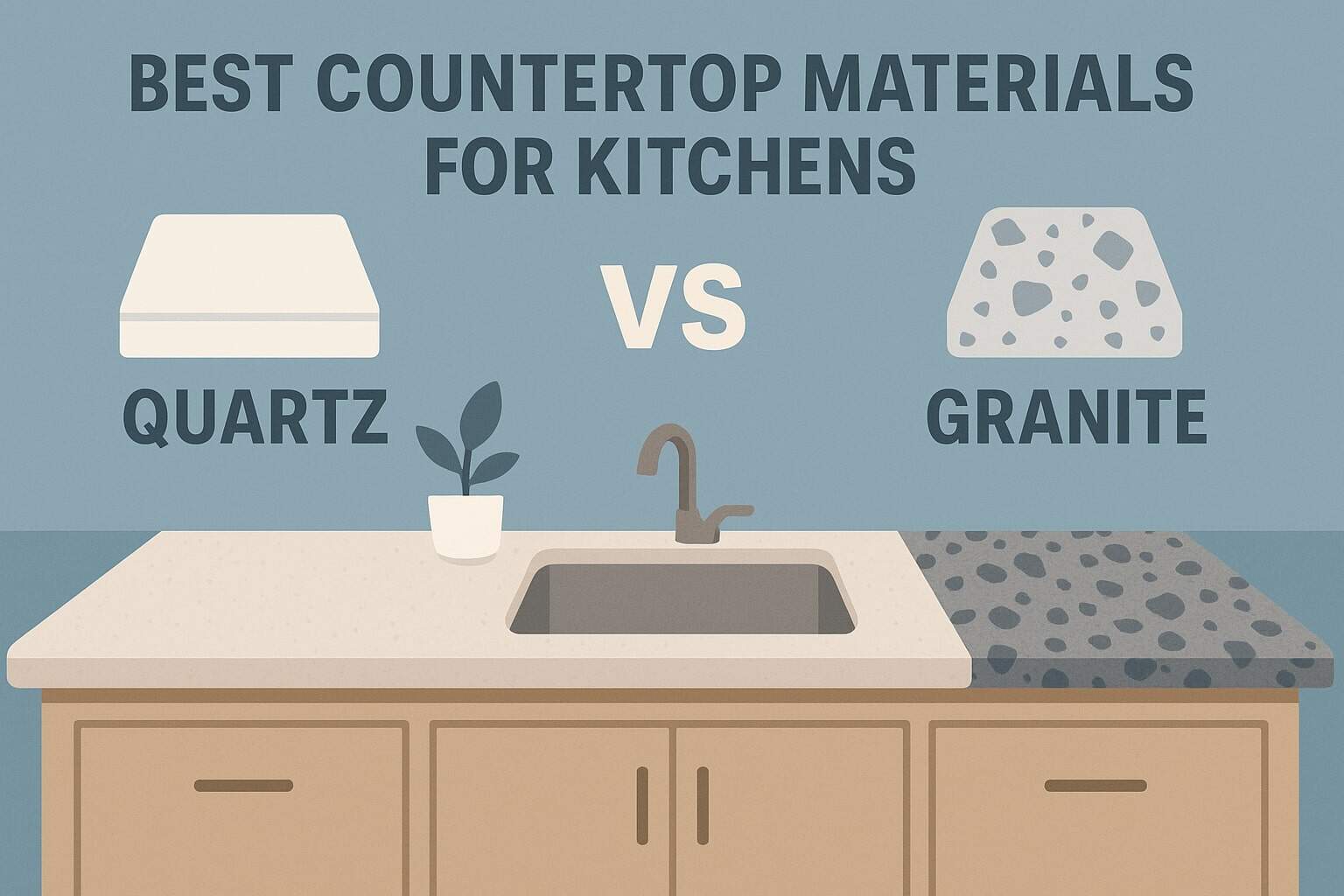
Choosing the best countertop materials for kitchens – quartz vs granite – is one of the biggest decisions you’ll make in a Delaware kitchen remodel. Countertops take daily abuse from chopping, hot pans, coffee spills, and kids’ science projects, so this is not just a “what looks pretty” choice.
It affects your home value, long-term maintenance, and how much you enjoy cooking in your Wilmington, Dover, Newark, or Rehoboth Beach home.
In this guide, we’ll walk through quartz and granite in detail—how they’re made, how they perform, what they cost specifically in Delaware, and which material is likely to stay in style and support resale value over the next 5–10 years.
We’ll keep circling back to the core question “What are the best countertop materials for kitchens: quartz vs granite?” and help you decide with real numbers and up-to-date trends.
Why Your Countertop Choice Matters in a Delaware Kitchen
Delaware homes range from historic rowhouses in Wilmington to newer construction in Middletown and coastal homes in Lewes and Bethany Beach. In all these settings, choosing between quartz vs granite countertops impacts more than aesthetics.
It shapes how your kitchen handles humidity, holiday cooking, and the daily wear that comes with East Coast family life.
Countertops usually account for a significant portion of a kitchen remodel budget. Nationally, homeowners can expect installed granite or quartz to fall somewhere in the $65–$190 per square foot range depending on material level and fabrication complexity, with quartz generally overlapping the same band.
In Delaware specifically, recent cost reports show average installed prices of about $91.47 per square foot for granite and $82.99 per square foot for quartz for a 1.25-inch slab. That’s real money, especially when you’re covering 40–60 square feet of counter space.
Climate matters too. Delaware summers are humid, and coastal homes may deal with salt air and intense sunlight. Natural stones like granite are more UV-resistant and handle direct sun well—something to consider if your kitchen has big south-facing windows or a sunroom extension.
Quartz, on the other hand, excels at stain resistance and low maintenance, which is ideal if you entertain often or have a busy family kitchen.
From a resale perspective, updated kitchens remain one of the top drivers of buyer interest, and countertops are a focal point. Research shows that high-end surfaces can add to perceived luxury and final sale price, particularly when listings highlight the material.
When potential buyers see “granite countertops” or “quartz countertops” in a Delaware MLS listing, they expect a durable, attractive surface. So the best countertop materials for kitchens: quartz vs granite aren’t just about your daily use—they also influence what your home will fetch if you sell within the next decade.
What Are Quartz Countertops? Composition, Look, and Performance
Quartz countertops are engineered stone: typically about 90% ground natural quartz crystals combined with resins, pigments, and other additives.
The result is a dense, non-porous surface that’s designed to mimic natural stone while improving stain resistance and consistency. When people ask about the best countertop materials for kitchens: quartz vs granite, quartz is often recommended for busy households that want high performance with minimal upkeep.
From a design standpoint, quartz is extremely flexible. Manufacturers can create everything from stark solid whites and modern concrete looks to soft marbled patterns that look like high-end Calacatta or Carrara marble.
This is one reason quartz has surged in popularity; the National Kitchen & Bath Association (NKBA) and multiple industry surveys report that the majority of designers expect quartz to keep growing as the top kitchen countertop material through 2025 and into 2026.
In a Delaware kitchen, quartz works particularly well if:
- You cook frequently with wine, sauces, and oils that can stain porous stone.
- You don’t want to deal with annual sealing (which is required for granite).
- You’re aiming for a bright, modern look in a townhouse or new subdivision home.
However, quartz has a few limitations. Because it contains resins, it is more sensitive to heat than granite. Most manufacturers recommend keeping surface temperatures under about 150°F to prevent yellowing, scorching, or resin damage.
That means you should never put a hot pan directly on quartz, especially in a Delaware beach house where big seafood boils and baking marathons are common. Trivets and hot pads are essential.
Overall, quartz offers an appealing balance of style, performance, and convenience, which is why it frequently tops lists of the best countertop materials for kitchens when homeowners compare quartz vs granite.
Durability and Maintenance of Quartz Countertops
When evaluating quartz vs granite for durability, quartz shines in everyday, real-world use. Because it’s engineered, quartz is non-porous, so it doesn’t need sealing. That means spills from red wine, tomato sauce, coffee, or Delaware’s famous peach cobbler are less likely to stain if you wipe them up promptly.
Quartz is extremely scratch-resistant and ranks high on the hardness scale, comparable to or sometimes surpassing granite in terms of scratch and impact resistance in many lab tests. It’s not indestructible—you can still chip an edge if you slam a heavy cast-iron pot—but it holds up very well in a busy family kitchen in Wilmington or Dover.
Maintenance is simple:
- Clean daily with mild dish soap and water or a pH-neutral stone cleaner.
- Avoid abrasive pads and harsh chemicals like paint strippers or oven cleaners.
- Always use trivets for hot pots and pans.
- Use cutting boards instead of cutting directly on the surface.
For Delaware homeowners used to seasonal humidity swings, the stable, resin-bound structure of quartz is another plus. It doesn’t expand or contract as much as some natural stones and is less sensitive to moisture infiltration.
That makes quartz a strong contender when comparing the best countertop materials for kitchens: quartz vs granite in older homes that may have slightly less stable cabinetry.
The main maintenance drawback is heat sensitivity. Granite can usually tolerate higher temperatures; quartz cannot. If your cooking style involves frequently transferring very hot pans directly from stove or oven to the counter, you’ll want to build “trivet habits” or consider granite for those high-heat zones.
Design and Style Options with Quartz in Delaware Kitchens
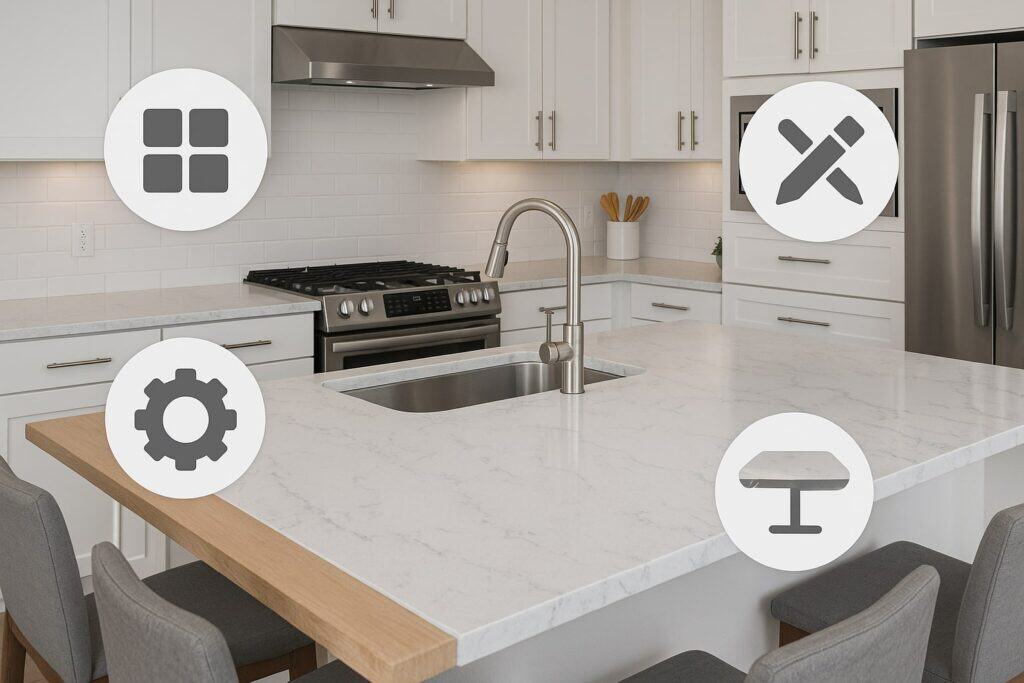
One of the biggest reasons quartz dominates best countertop materials for kitchens lists is its design flexibility. Because quartz is manufactured, brands can control color and pattern with precision, which appeals to Delaware homeowners looking for a curated, modern aesthetic.
Popular quartz looks in 2024–2026 include:
- Warm white with subtle veining – A soft marble-style pattern that works beautifully with Shaker cabinets in Wilmington rowhomes or new construction in Middletown.
- Concrete-inspired greys – Perfect for industrial or modern kitchens, especially in loft-style apartments near Wilmington’s Riverfront.
- Bold veining and book-matching – Large dramatic veins that create a statement island surface, sometimes book-matched to flow across waterfall edges.
- Earthy beiges and taupes – Great for traditional Delaware homes that want updated counters without looking too stark or ultra-modern.
Because patterns are consistent from slab to slab, it’s easier to match seams and plan layouts—helpful when your kitchen has long runs or a large island. That consistency is a major selling point compared to granite, where every slab is unique.
Looking ahead, industry trend reports predict quartz will continue to dominate countertop installations through at least 2026, with growing interest in:
- Matte and honed finishes instead of high-gloss.
- Eco-conscious lines, including recycled content or reduced resin formulas.
- Integrated backsplashes and waterfall islands using the same quartz material.
For Delaware homeowners wanting a future-forward kitchen that aligns with national design trends, quartz is likely to remain a top choice in the quartz vs granite debate.
Cost of Quartz Countertops in Delaware
Nationally in 2025, installed quartz countertops usually range from about $50 to $120 per square foot, depending on the brand, color, thickness, and fabrication complexity.
However, local market conditions matter. In Delaware, recent cost data places average installed quartz at around $82.99 per square foot for a 1.25-inch slab, with a typical range of about $72.74–$93.23 per square foot.
What affects your final price for quartz vs granite in Delaware?
- Color and pattern – Simple solid colors or common patterns cost less; dramatic marbled designs and premium brands cost more.
- Edge profiles – Standard eased edges are cheaper; fancy ogee or mitered waterfall edges add fabrication cost.
- Cutouts and complexity – Sinks, cooktops, curves, and multiple seams increase labor.
- Project size – Very small projects may cost more per square foot because fabrication shops have a minimum job price.
Delaware has no state sales tax, which helps offset some costs versus neighboring states. But labor and transportation from regional fabrication shops still affect your bottom line.
If you’re comparing the best countertop materials for kitchens: quartz vs granite for a 50-square-foot kitchen, that average Delaware quartz price translates roughly to:
- Low end: 50 sq ft × $73 ≈ $3,650
- Average: 50 sq ft × $83 ≈ $4,150
- Upper end: 50 sq ft × $93 ≈ $4,650
These figures typically include templating, fabrication, and installation but not always plumbing reconnection or removal of old countertops, so always confirm with your local Delaware countertop contractor.
Pros and Cons of Quartz Countertops
When choosing the best countertop materials for kitchens: quartz vs granite, it helps to lay out the pros and cons clearly.
Pros of Quartz:
- Non-porous and very stain-resistant – No sealing required; resists most food and drink spills.
- Super low maintenance – Easy cleaning; ideal for busy families and rental properties.
- Wide range of designs – From marble-like veining to solid modern hues, with excellent pattern consistency.
- Strong resale appeal – Buyers often perceive quartz as a premium, modern material.
- Good scratch and impact resistance – With normal use, holds up very well.
Cons of Quartz:
- Heat sensitivity – Hot pans can scorch or discolor the resin; trivets are mandatory.
- Not ideal for outdoor kitchens – UV exposure can cause fading and damage.
- Less “natural” variation – Some homeowners prefer the one-of-a-kind look of granite.
- Can be similar in price or more expensive than entry-level granite depending on color and brand.
For many Delaware homeowners, the advantages—especially stain resistance and easy care—make quartz feel like the best countertop material for kitchens when compared head-to-head with granite.
What Are Granite Countertops? Natural Stone Beauty and Performance
Granite is a 100% natural stone, quarried in large blocks and then cut and polished into slabs. Each slab features a unique mix of minerals, veins, and speckles, which is a big part of its appeal. When homeowners think of classic high-end kitchen updates, “granite countertops” often come to mind first.
Granite has long been one of the best countertop materials for kitchens because it’s hard, heat-resistant, and offers a distinctive natural look that manufactured surfaces can only approximate.
While quartz popularity has surged, granite remains a strong option for Delaware households that love traditional or transitional style and want a natural-stone story to tell.
Granite slabs vary widely in color, from whites and creams to dramatic blacks, blues, and greens. The mineral composition determines not only the color but also how speckled, veined, or movement-heavy the stone appears.
In a Delaware colonial-style home, a classic black or dark brown granite can pair beautifully with white or stained wood cabinets, while lighter granites brighten compact kitchens in Wilmington condos.
Unlike quartz, granite is porous, so it does require periodic sealing to resist stains. However, when sealed properly and maintained reasonably, granite can provide decades of service with minimal issues.
Many granite installations from the early 2000s are still going strong today. As you compare quartz vs granite, granite may win if your top priorities are natural beauty, heat tolerance, and long-term durability.
Durability and Maintenance of Granite Countertops
In the quartz vs granite durability debate, granite has a clear lead in one area: heat resistance. As a natural stone without resin binders, granite can tolerate higher heat, making it more forgiving if you occasionally set a hot pan on the surface (though trivets are still recommended to avoid thermal shock or potential cracking).
Granite is also very hard and resistant to everyday scratching. Cutting directly on a granite countertop is more likely to dull your knives than damage the stone, though using a cutting board is still smart to protect both.
This toughness makes granite one of the best countertop materials for kitchens in Delaware homes where cooking is frequent and sometimes intense—think holiday feasts or crab boils.
Maintenance requirements differ from quartz:
- Sealing – Granite should be sealed on a schedule recommended by your fabricator, often every 1–3 years, depending on the specific stone and sealer.
- Cleaning – Use mild, pH-neutral cleaners; avoid harsh acids and bleach that can etch or damage the sealer.
- Spill management – Wipe up oil, wine, and acidic foods promptly to prevent potential staining or etching.
In Delaware’s humid summers, properly sealed granite resists moisture well, but failure to maintain the sealer can leave it more vulnerable to stains than quartz.
Over decades, though, a well-maintained granite countertop can look nearly as good as the day it was installed, which is why many still consider it among the best countertop materials for kitchens.
Design and Style Options with Granite in Delaware Kitchens
Granite’s biggest design advantage in the quartz vs granite conversation is its one-of-a-kind natural variation. No two slabs are identical, so your countertop is as unique as a fingerprint. For Delaware homeowners who love character and natural materials—especially in historic or custom homes—this can be a decisive factor.
Popular granite looks include:
- Classic speckled patterns (like Santa Cecilia or Giallo Ornamental) that pair well with traditional cabinetry.
- Bold, dramatic slabs with sweeping veins or movement for statement islands.
- Dark, near-black granites (like Black Pearl or Absolute Black) for sleek, modern or transitional spaces.
Because granite is natural, what you see in a small sample may not fully represent the slab. In Delaware showrooms—like those serving Wilmington, Newark, and Dover—it’s smart to view full slabs and tag the exact ones you want before templating.
Many local fabricators also work across state lines with Pennsylvania and Maryland quarries, giving you more choice.
Design trends in 2024–2026 show granite being specified less often than quartz overall, but it remains popular in:
- Homes with traditional or rustic styles.
- Outdoor kitchens, where UV resistance and weather tolerance matter.
- Projects where homeowners want natural-stone prestige rather than engineered surfaces.
If your vision of the best countertop materials for kitchens involves natural story and variation, granite is still a serious contender in Delaware, even as quartz leads the trend charts.
Cost of Granite Countertops in Delaware
Granite pricing in 2025 varies by stone rarity, origin, and complexity of the project. Nationally, installed granite can range from around $50–$200 per square foot, with typical mid-range projects falling between $70–$120 per square foot.
In Delaware, the average reported cost for granite countertop installation is approximately $91.47 per square foot for a 1.25-inch level-1 custom slab, with a range of about $86.32–$96.61 per square foot.
That’s slightly higher than the average for quartz in the same state, which can surprise homeowners who assume natural stone is always cheaper.
Factors that can push your Delaware granite price up or down include:
- Level (grade) of granite – Entry-level colors cost less; exotic stones from distant quarries can be much more expensive.
- Edge treatments and details – Complex edges, full-height backsplashes, and mitered waterfalls raise fabrication costs.
- Remnants vs full slabs – Small projects like bathroom vanities or small galley kitchens can sometimes use remnants at lower per-square-foot prices.
For a typical 50-square-foot Delaware kitchen, that average granite price equates roughly to:
- Lower range: 50 sq ft × $86 ≈ $4,300
- Average: 50 sq ft × $91 ≈ $4,550
- Upper range: 50 sq ft × $97 ≈ $4,850
Comparing these numbers to the quartz estimates shows that, in Delaware, quartz may be slightly more budget-friendly on average, though both materials are in a similar premium band. This cost comparison is key when deciding the best countertop materials for kitchens: quartz vs granite for your specific project.
Pros and Cons of Granite Countertops
To fairly evaluate quartz vs granite, you need a clear picture of granite’s perks and limitations.
Pros of Granite:
- Excellent heat resistance – More tolerant of hot pans and pots than quartz, though trivets are still recommended.
- Unique natural beauty – Every slab is different; ideal if you want a one-of-a-kind kitchen.
- High durability and longevity – With proper sealing and basic care, granite can last for decades.
- Great for outdoor or sun-drenched spaces – UV resistant and weather-tolerant.
Cons of Granite:
- Porous and requires sealing – Needs periodic maintenance to maintain stain resistance.
- More variable appearance – What you see in a sample may not match your final slab perfectly.
- More susceptible to certain stains if not sealed properly – Oils and pigmented liquids can penetrate.
- Slightly higher average cost than quartz in Delaware based on recent cost reports.
If your priorities are natural stone, heat tolerance, and long-term durability—and you’re willing to keep up with sealing—granite can still be one of the best countertop materials for kitchens in Delaware, even as quartz leads in market share and low maintenance.
Quartz vs Granite: Side-by-Side for Delaware Homeowners
When Delaware homeowners ask “What are the best countertop materials for kitchens: quartz vs granite?”, they’re really asking how each material performs in their day-to-day life and climate. Here’s how they stack up in key categories.
Durability & Everyday Use
- Quartz: Outstanding resistance to scratches and everyday stains; non-porous and easy to keep sanitary. However, it’s sensitive to high heat.
- Granite: Very hard and scratch-resistant, with superior heat tolerance, especially for occasional hot pans. Needs sealing to maintain stain resistance.
Maintenance
- Quartz: Wipe and go, no sealing required. Ideal for busy households in Wilmington, Dover, and Newark.
- Granite: Requires periodic sealing and more careful handling of oil and acidic spills—but still manageable for most homeowners.
Style & Design
- Quartz: Consistent patterns, wide range of colors, and a strong match with modern and transitional Delaware kitchens.
- Granite: Organic movement, natural beauty, and a sense of uniqueness perfect for custom or historic homes.
Cost in Delaware
- Quartz: Average ~$83 per sq ft installed.
- Granite: Average ~$91 per sq ft installed.
Resale & Trends
- National kitchen trend reports show quartz gaining market share and expected to dominate through at least 2026, while granite’s popularity is slowly declining but still meaningful.
In short:
- If you want low maintenance, modern style, and strong resale alignment with future buyers, quartz usually wins as the best countertop material for kitchens.
- If you value natural stone, heat tolerance, and unique variation, granite remains a top-tier option.
Environmental and Health Factors: Radon, Resins, and Sustainability
Another angle in the quartz vs granite decision is environmental and health impact.
Radon Concerns with Granite
Granite is a natural stone, and like many rocks, it can contain trace amounts of radioactive minerals that emit radon gas. However, extensive testing and reviews have generally concluded that granite countertops are not a significant source of radon in homes, and levels are usually far below safety thresholds.
Most radon issues in Delaware homes relate more to soil gas infiltration than countertops, and testing/mitigation focuses on the foundation, not the kitchen.
Resins and VOCs in Quartz
Quartz is engineered with resins and pigments. Modern products from reputable brands are designed to comply with low-VOC and indoor air quality standards, but very cheap or unbranded imports could potentially have less transparent formulations.
Many major manufacturers now emphasize Greenguard or similar certifications to show that emissions are minimal and safe for indoor use. Over time, the market trend is toward more eco-friendly binders and recycled content.
Sustainability and Sourcing
- Granite: Quarrying and trans-ocean shipping can have a sizable environmental footprint, but granite’s extreme longevity and potential for reuse as slabs or reclaimed stone partially offset this.
- Quartz: Uses crushed stone (sometimes from quarry by-products) and can incorporate recycled content. However, resin production is petroleum-based. On the upside, quartz’s durability and low maintenance can reduce the need for replacements and harsh chemical cleaners over time.
For Delaware homeowners seeking the best countertop materials for kitchens with sustainability in mind, look for:
- Quartz brands with recycled content and low-VOC certifications.
- Granite from regional or domestic quarries to reduce transportation impact.
- Fabricators who recycle slurry and stone waste.
Over the next decade, expect more eco-focused quartz lines and alternative surfaces (like sintered stone/porcelain) to enter the mainstream, giving environmentally conscious homeowners more options alongside traditional quartz vs granite.
Future Trends: Which Will Win Long-Term—Quartz or Granite?
Looking at recent NKBA trend reports and design surveys, quartz is positioned to remain the dominant “best countertop material for kitchens” nationally through 2026 and likely beyond. Designers increasingly specify quartz for its low maintenance, consistent look, and compatibility with both modern and transitional styles.
Key future trends affecting the quartz vs granite decision in Delaware:
- Quartz dominance in new builds – Many new subdivisions and higher-end townhomes in the Wilmington and Middletown areas already include quartz as the standard or “preferred upgrade.”
- Granite shifting to niche and outdoor roles – Granite remains strong for outdoor kitchens, rustic homes, and anyone wanting unique natural stone. It’s less common as the default choice in brand-new, style-driven kitchens.
- Rise of quartzite and porcelain – Quartzite (a natural stone) and porcelain/sintered slabs are gaining attention for combining durability and heat resistance with striking looks, adding more competition to both quartz and granite.
- Matte and integrated surfaces – Solid surfaces that extend up the backsplash and form waterfall islands create seamless visual lines that quartz handles very well. Granite can do this too, but the pattern unpredictability sometimes makes seams more noticeable.
For Delaware over the next 5–10 years, it’s reasonable to predict:
- Quartz will be the most common choice in remodeled and new kitchens, especially near urban and suburban centers.
- Granite will maintain a loyal following among homeowners who love natural stone or who are designing for a more traditional or rustic aesthetic.
- When it comes time to sell, listings that mention “quartz countertops” are likely to resonate strongly with buyers familiar with current design trends.
So if your goal is to align with where the market is going, quartz edges out granite as the long-term best countertop material for kitchens—but granite will remain a respected, high-end option rather than disappearing.
How to Choose the Best Countertop Material for Your Delaware Kitchen
When you’re comparing the best countertop materials for kitchens: quartz vs granite for your Delaware home, use this step-by-step approach:
- Clarify Your Lifestyle
- Do you cook daily, host big gatherings, or have young kids?
- Are you likely to set hot pans on the counter?
- How much time do you realistically want to spend on maintenance like sealing?
- Do you cook daily, host big gatherings, or have young kids?
- If your life is busy and you want maximum convenience, quartz often wins. If you’re a serious cook who values heat tolerance and doesn’t mind sealing, granite is compelling.
- Define Your Design Style
- Modern, minimalist, or Scandinavian? Quartz’s consistent, clean patterns and whites/greys are ideal.
- Traditional, farmhouse, or coastal rustic? Granite’s natural movement and earthy tones may feel more authentic.
- Modern, minimalist, or Scandinavian? Quartz’s consistent, clean patterns and whites/greys are ideal.
- Set a Realistic Budget
- Get quotes from at least two or three Delaware countertop contractors, asking for both quartz and granite options in similar quality tiers.
- Compare total installed costs, not just per-square-foot numbers. Factor in removal of old tops, plumbing, and any custom edges.
- Get quotes from at least two or three Delaware countertop contractors, asking for both quartz and granite options in similar quality tiers.
- Visit Slab Yards and Showrooms
- View full granite slabs in person; photos rarely capture full movement and color.
- For quartz, ask to see large samples or installed displays of your top choices.
- View full granite slabs in person; photos rarely capture full movement and color.
- Think About Resale Timing
- Planning to sell within 3–5 years? Lean toward quartz to match current buyer expectations, especially in more competitive Delaware markets.
- Planning to stay for 10+ years? Choose whichever material you truly love living with day-to-day.
- Planning to sell within 3–5 years? Lean toward quartz to match current buyer expectations, especially in more competitive Delaware markets.
- Consider Future Trends and New Materials
- Ask fabricators about quartz lines with improved heat resistance, eco certifications, or lower resin content.
- If you’re adventurous, you might compare quartz vs granite vs emerging materials like porcelain slabs and quartzite.
- Ask fabricators about quartz lines with improved heat resistance, eco certifications, or lower resin content.
By walking through these steps, you’re not just picking a countertop—you’re choosing the best countertop material for your kitchen that fits your Delaware home, your daily routine, and your long-term plans.
FAQs
Q1. Which is better for a busy family kitchen in Delaware: quartz or granite?
Answer: For a busy family kitchen, quartz usually edges out granite as the best countertop material. Quartz is non-porous, highly stain-resistant, and doesn’t require periodic sealing, which simplifies life when you’re juggling work, school, and activities.
Spilled juice, pasta sauce, or coffee is less likely to leave a permanent mark if wiped up in a reasonable time.
Granite, while very durable, does require regular sealing to maintain stain resistance. If you forget or delay sealing, oils and pigmented liquids can penetrate the surface more easily.
In a busy Delaware home where multiple family members use the kitchen, that extra maintenance step can become a hassle. On the flip side, granite offers better heat resistance, which matters if you frequently handle hot pans and bakeware.
So if your top priority is low-stress maintenance and keeping the kitchen looking fresh with minimal effort, quartz is typically the better family-friendly choice.
If your household is comfortable with a bit more maintenance and you value natural stone and heat tolerance, granite is still a strong candidate in the quartz vs granite conversation.
Q2. Are quartz countertops more expensive than granite in Delaware?
Answer: Many homeowners assume quartz is always more expensive, but current data shows a more nuanced picture—especially in Delaware.
Statewide cost reports indicate that, on average, granite countertops cost about $91.47 per square foot installed, while quartz averages around $82.99 per square foot, both for 1.25-inch slabs. That means quartz can actually be slightly less expensive on average in Delaware, particularly for common colors and mid-range product lines.
Nationally, both materials occupy similar price ranges for installed projects—roughly $50–$120+ per square foot, depending on quality and complexity. Exotic granites and premium designer quartz lines can both climb higher. What really matters is the specific color, brand, and job complexity.
For your Delaware kitchen, the best approach is to request side-by-side quotes for quartz vs granite in similar styles from the same fabricator. That way, you’ll see how the numbers shake out for your cabinet layout, edge choice, and local labor rates.
In many cases, quartz will come in close to—or slightly below—comparable granite, reinforcing its position among the best countertop materials for kitchens on a value basis.
Q3. Do quartz or granite countertops add more resale value in Delaware?
Both quartz and granite are viewed as premium countertop materials that boost a kitchen’s appeal and help a listing stand out. Buyers often filter MLS searches using keywords like “granite countertops” and “quartz countertops,” and updated kitchens remain one of the biggest selling points across the U.S.
However, current design trends give quartz a modest edge. NKBA trend data and design surveys show a clear shift toward quartz as the preferred countertop material among designers and homeowners, with quartz projected to dominate in 2025–2026.
For Delaware buyers—especially younger ones and those relocating from major metro areas—“quartz countertops” often signal a more modern, low-maintenance, move-in-ready kitchen.
That doesn’t mean granite hurts resale value—far from it. A well-chosen granite that fits the home’s style can absolutely help your Wilmington or Newark property show well and sell faster.
But if your primary goal is to align with where buyer preferences are headed over the next 5–10 years, quartz is increasingly the safer bet in the quartz vs granite decision for maximizing resale appeal.
Q4. Which is safer and healthier: quartz or granite countertops?
Answer: Both quartz and granite are considered safe, food-prep-friendly surfaces when installed and maintained properly. The main health and safety concerns people quote involve radon in granite and resins in quartz.
Granite, being natural stone, can contain trace radioactive elements. But extensive studies and industry testing have found that radon emissions from granite countertops are generally extremely low and not a significant contributor to indoor radon levels.
Most radon concerns in Delaware relate to soil gas under the foundation, which is why home inspectors recommend basement or crawlspace radon testing rather than worrying about the counters.
Quartz contains polymer resins and pigments. Reputable brands formulate their products to meet strict VOC and indoor air quality standards. Many carry certifications like Greenguard, indicating that emissions are low and considered safe for residential use.
For everyday use in a Delaware kitchen, both materials are sanitary and safe when you:
- Clean with mild, non-toxic cleaners.
- Avoid harsh chemicals or strong solvents on the surface.
- Repair or replace any chipped or damaged edges that might trap food or bacteria.
From a health and safety standpoint, the choice of best countertop materials for kitchens: quartz vs granite comes down more to maintenance and household habits than any inherent danger in the materials themselves.
Conclusion
When you weigh all the factors—durability, maintenance, cost, design, trends, and resale—both quartz and granite qualify as best countertop materials for kitchens. The real question is which material is best for your Delaware kitchen and your plans over the next decade.
- Choose quartz if you want:
- Super-easy maintenance and excellent stain resistance.
- A clean, modern look with consistent patterns and colors.
- Strong alignment with current and future design trends that appeal to buyers.
- Slight cost advantages in Delaware on average, especially for mid-range options.
- Super-easy maintenance and excellent stain resistance.
- Choose granite if you want:
- Natural-stone beauty with unique character in every slab.
- Superior heat resistance and rock-solid durability.
- A classic, timeless look that suits traditional or rustic Delaware homes.
- A material that performs well in outdoor or sun-intense areas.
- Natural-stone beauty with unique character in every slab.
For many Delaware homeowners in 2025 and beyond, quartz will be the default “best countertop material for kitchens” when comparing quartz vs granite, thanks to its low maintenance and trend-friendly style. Yet granite continues to hold its ground as a luxurious natural stone option that can elevate the right home and design.
If you’re still on the fence, the next step is simple: visit a local Delaware showroom, view both quartz and granite slabs in person, get a couple of itemized quotes, and imagine how each will feel under your hands during your daily routine.
The best countertop for your kitchen is the one that fits your life, your style, and your long-term plans—whether that’s quartz, granite, or a smart combination of both.