Renovating in a small state like Delaware can feel simpler than tackling a project in a big metro—but the numbers can still be confusing. The cost to renovate a home in Delaware varies widely based on location, scope, and finish level, and recent changes in material prices, tariffs, and tax credits make it more important than ever to plan carefully.
This guide walks you through realistic cost ranges, local rules, and future trends so you can budget with confidence.
Understanding the Current Cost to Renovate a Home in Delaware
When people ask about the cost to renovate a home in Delaware, they usually want a ballpark per-square-foot number. For a typical primary residence in 2025, a whole-home renovation in the U.S. often runs $15–$60 per square foot for light to moderate upgrades and up to $150 per square foot or more for high-end, structural, or “down to the studs” projects.
In Delaware, most homeowners fall somewhere in the middle of those ranges, with coastal and Wilmington-area projects trending toward the higher end due to demand and labor rates.
For a 2,000-square-foot Delaware home, that means a cosmetic refresh might land from $30,000–$70,000, while a deeper remodel that reconfigures rooms, updates systems, and upgrades finishes can easily reach $120,000–$250,000+, especially if you include kitchens, bathrooms, and exterior work.
Kitchen remodels alone can range from $20,000–$30,000 for a minor update to $60,000–$100,000+ for a major project in Delaware.
Bathrooms show similar spread, with many Delaware bathroom remodels falling between $8,000 and $30,000, and luxury or primary-suite baths going higher.
Another part of the cost to renovate a home in Delaware comes from permits and compliance. In most counties, almost any structural change, addition, or major system upgrade requires a building permit, and some municipalities list minimum permit fees of around $140+ for residential renovation projects, with additional charges based on project valuation.
These fees are a small percentage of your total budget but can add up when combined with zoning reviews, inspections, and impact fees.
Looking ahead, several forces are pushing renovation costs upward: material price volatility, new tariffs on imported cabinetry and furniture, and continuing skilled-labor shortages.
Recent tariffs on imported kitchen and bath cabinetry are already expected to increase renovation costs, particularly in projects that rely on imported products. At the same time, energy-efficiency credits and Delaware-specific rebate programs offset part of the cost of certain upgrades, especially insulation, HVAC, and electrification.
Key Factors Affecting the Cost to Renovate a Home in Delaware
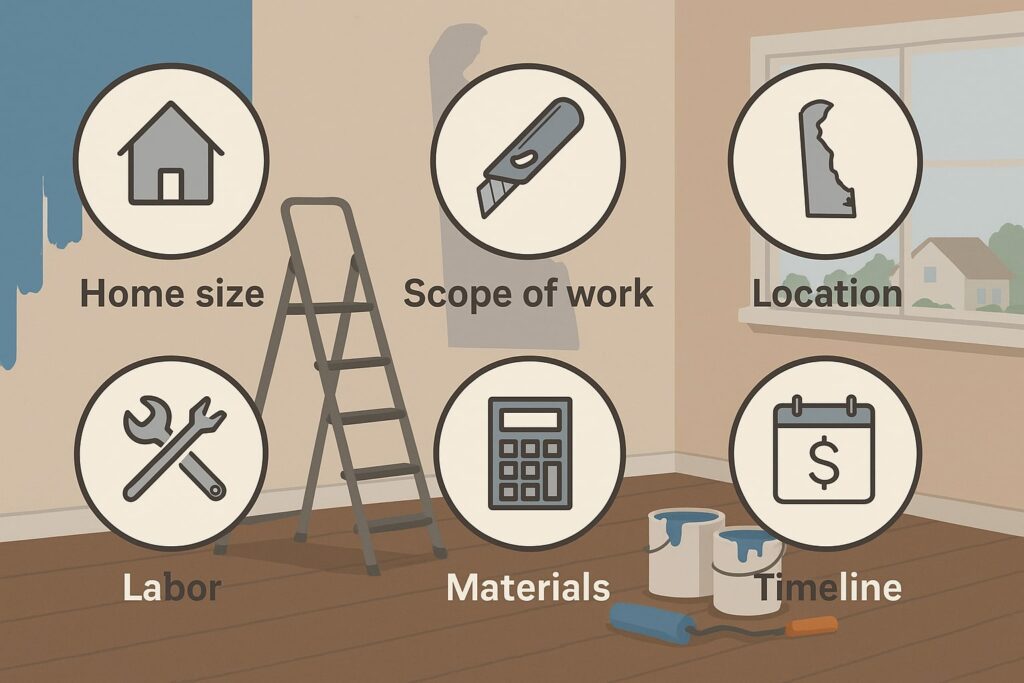
The cost to renovate a home in Delaware isn’t a single number—it’s the sum of several big levers you can partially control. Understanding these helps you decide where to splurge and where to save.
Size, Scope, and Existing Condition
The most basic driver of the cost to renovate a home in Delaware is scope. A “pull and replace” cosmetic update, where you keep the same layout and simply refresh finishes, is far cheaper than a structural reconfiguration that involves moving walls, plumbing, or stairs.
A 1,200-square-foot bungalow with good bones might only need new floors, paint, and updated fixtures, while a neglected 3,000-square-foot property could require full electrical, plumbing, and structural corrections.
Existing condition matters as much as size. Older Delaware homes—especially those in historic areas of Wilmington or near the coast—may uncover hidden problems such as outdated knob-and-tube wiring, undersized electrical panels, termite damage, or moisture issues.
These issues don’t always show up during a basic walk-through, but they can easily add 10–30% to the cost to renovate a home in Delaware once demolition begins. Nationally, whole-house renovations on larger homes often range from $50,000 to $180,000+, and extensive issues can push well beyond that.
Scope decisions can be strategic. Instead of tackling the entire home at once, some Delaware homeowners phase work over several years, starting with kitchens and bathrooms, then moving to floors, doors, and paint.
This approach can keep the cost to renovate more manageable and align projects with available rebates, tax credits, or favorable contractor schedules.
Materials, Finishes, and Product Choices
Materials and finish level can make or break the cost to renovate a home in Delaware. You can often complete the same basic project with budget, mid-range, or luxury finishes, each with vastly different price tags.
Vinyl plank flooring, for example, is significantly cheaper than solid hardwood or wide-plank white oak, which has become a premium trend in listings and can increase perceived value.
Cabinetry is one of the biggest swing items for kitchens and baths. Stock or semi-custom cabinets from big-box stores keep costs down, while fully custom cabinetry can double or triple cabinet lines, especially with current tariffs on imported products.
Countertop choices—laminate versus quartz or quartzite—also dramatically affect the cost to renovate a home in Delaware, and high-end surfaces may run into hundreds of dollars per square foot.
Choosing mid-range products is often the sweet spot: durable, attractive, and widely available, without the premium of designer finishes. Many Delaware contractors steer homeowners toward mid-range fixtures and appliances that offer good warranties and energy efficiency without pushing you into luxury pricing.
Labor Rates and Contractor Expertise in Delaware
Labor is typically 40–60% of the cost to renovate a home in Delaware, and it varies by contractor type and location. High-demand trades like electricians, plumbers, and HVAC specialists often charge higher rates, especially for complex projects or homes with older systems.
Skilled general contractors with good local reputations, insurance, and references will usually cost more than an unlicensed handyman—but they tend to manage projects better, avoid code violations, and reduce the risk of costly rework.
In Delaware, as in much of the U.S., ongoing labor shortages in skilled trades keep upward pressure on costs. Some homeowners try to reduce the cost to renovate by handling demolition, painting, or simple finish work themselves, but structural, electrical, and mechanical work should remain in professional hands for safety and compliance reasons.
Location Within Delaware: Wilmington, Dover, and the Beaches
Your ZIP code plays a real role in the cost to renovate a home in Delaware. Projects near Wilmington typically have higher labor and subcontractor costs than some rural areas due to greater demand and higher overhead.
Kitchen and bath specialists near the Pennsylvania border, for example, often publish mid-range kitchen remodeling estimates in the $25,000–$75,000 range, with high-end projects exceeding $100,000.
In Sussex County and coastal towns such as Rehoboth Beach, Lewes, and Bethany Beach, you may see price premiums tied to second homes, short-term rentals, and stricter building standards in coastal or flood zones.
These realities can increase the cost of materials, engineering, and insurance, all of which feed into the overall cost to renovate a home in Delaware in those areas. Rural properties may offer lower labor rates but incur higher travel fees or fewer contractor options, which can affect schedule and pricing.
Permits, Codes, and Inspections
Permits and code compliance are often underestimated parts of the cost to renovate a home in Delaware. Most counties require permits for structural changes, additions, decks, accessory dwelling units, and significant system upgrades.
New Castle County, for instance, publishes an estimated renovation permit fee form with minimum fees around $142 plus valuation-based charges. Rehoboth Beach and other municipalities list separate building and licensing fees, including tree plan reviews, board applications, and re-inspection costs.
Permits add not only direct fees but also design and administrative hours. You might need drawings from a design-build firm, draftsman, or architect, especially for additions or interior reconfigurations.
Inspections can also reveal necessary upgrades—like adding smoke detectors, GFCI outlets, or guardrails—to bring older Delaware homes up to modern safety standards. These requirements protect you, but they do increase the total cost to renovate a home in Delaware.
Room-by-Room Costs to Renovate a Home in Delaware
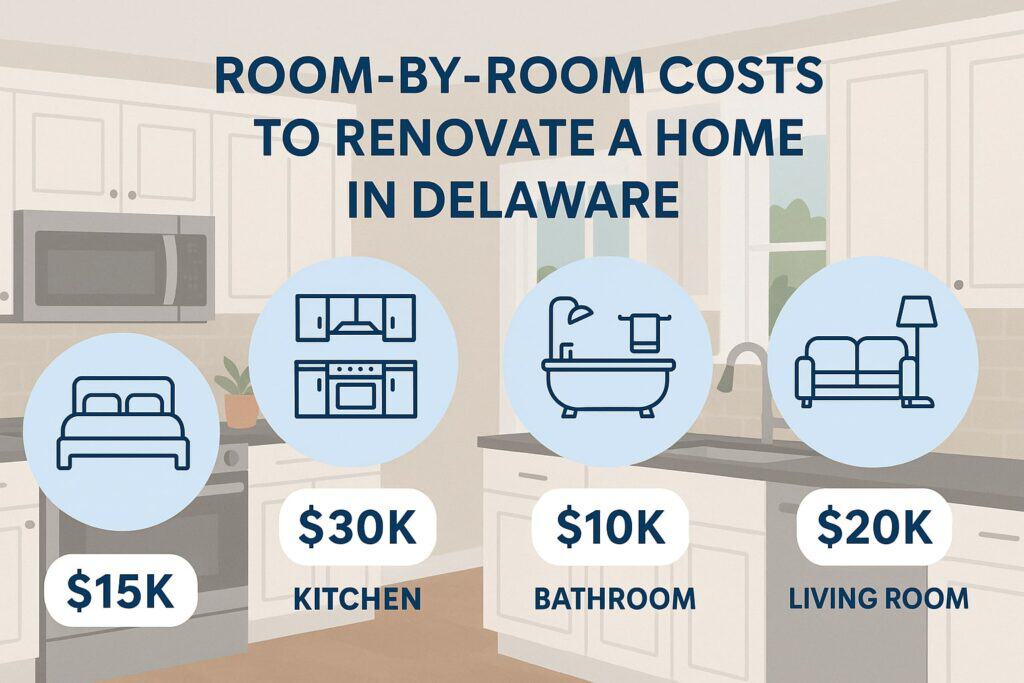
Breaking down the cost to renovate a home in Delaware by room or system is often more helpful than a single lump-sum number. Here’s what typical homeowners can expect by area.
Kitchen Renovation Costs in Delaware
Kitchens are usually the most expensive room to update, but they also deliver strong resale value. Nationally, mid-range major kitchen remodels average around $27,000–$80,000, with upscale projects far higher. In Delaware specifically, local contractors commonly quote:
- Minor kitchen remodel: ~$20,000–$30,000 (refresh cabinets, counters, flooring, lighting without moving plumbing).
- Mid-range remodel: ~$40,000–$75,000 (semi-custom cabinets, new countertops, some layout changes).
- Major / high-end remodel: $75,000–$120,000+, especially with structural changes, high-end appliances, or custom cabinetry.
For many households, kitchens represent the single biggest chunk of the cost to renovate a home in Delaware. If your overall budget is $150,000, it’s common to see $50,000–$80,000 go into the kitchen alone. Features like large custom islands, high-end stone, or built-in pantries can add tens of thousands of dollars.
Future-wise, kitchen remodel costs in Delaware are likely to remain elevated due to tariffs on imported cabinetry and furniture, which can raise prices 15–30% on some product lines. At the same time, energy-efficient appliances and induction ranges may qualify for rebates or tax incentives in specific programs, partially offsetting costs.
Bathroom Renovation Costs in Delaware
Bathrooms are the second-most expensive area when calculating the cost to renovate a home in Delaware. Delaware-based contractors and cost guides show:
- Basic update (powder room or small bath): often $3,000–$8,000, focusing on fixtures and finishes without moving plumbing.
- Mid-range partial remodel: typically $8,000–$18,000, including new tub or shower, tile, and upgraded fixtures while keeping layout similar.
- Full or luxury bath remodel: $25,000–$70,000+ for large primary suites with custom tile, frameless glass, heated floors, and built-ins.
In terms of the cost to renovate a home in Delaware, even one high-end bathroom can consume a big slice of your total budget. However, bathrooms deliver strong resale value and are central to quality of life.
Aging-in-place features such as curbless showers, grab bars, and comfort-height toilets are increasingly popular, often costing $6,000–$12,000 for accessible shower conversions alone. These investments may add long-term livability and appeal to future buyers who value accessible design.
Living Rooms, Bedrooms, and Common Areas
Living rooms, dining rooms, and bedrooms typically cost less per square foot than kitchens or baths. When you look at the cost to renovate a home in Delaware, most of these spaces involve:
- New flooring
- Paint and trim
- Lighting and electrical updates
- Possibly new doors and windows
Per-room costs can range from a few thousand dollars for basic paint and flooring to $10,000–$20,000+ per space if you’re adding built-ins, custom millwork, fireplaces, or high-end finishes.
If you’re updating several rooms at once, your contractor may give you better pricing on materials and labor by handling floors, paint, and trim in one coordinated phase.
For many Delaware homes, a whole-house cosmetic refresh—floors, paint, basic lighting, and door hardware—might add $20,000–$40,000 to the overall cost to renovate a home in Delaware, depending on square footage and product choices.
Combined with kitchen and bath upgrades, these areas round out the “move-in ready” feel buyers pay premiums for.
Basements, Attics, and Bonus Spaces
Finishing or renovating basements and attics can significantly increase the perceived value of your home and offer extra living or storage space.
In Delaware, where basements are common, turning an unfinished basement into a living area with a bedroom, bathroom, and rec room often costs $30,000–$80,000+, depending on moisture control, egress windows, and bathroom scope.
If your basement needs waterproofing, drainage, or structural work, expect those upgrades to add thousands—sometimes $10,000–$20,000+—to your total cost to renovate a home in Delaware.
Attic conversions, especially those adding dormers and structural framing, can also be expensive due to engineering, insulation, and code requirements such as proper staircases and egress.
These projects can be smart investments if they add legally countable bedrooms or increase heated square footage, but they require careful planning with a local architect or design-build firm to meet Delaware building codes and fire egress rules.
Exterior Upgrades: Roofing, Siding, Windows, and Decks
The exterior is a major line item in the cost to renovate a home in Delaware, especially in coastal areas where salt, wind, and moisture wear on materials. Common exterior costs include:
- Roof replacement: often $8,000–$20,000+ depending on size and material.
- Siding replacement: vinyl is relatively affordable, while fiber cement or upscale cladding can significantly increase costs.
- Window and door replacement: modern, energy-efficient windows add comfort and may qualify for tax credits or rebates.
- Decks and porches: New decks or rebuilds can run from $8,000–$25,000+, especially if you use composite materials and need engineering in flood or wind zones.
These improvements may not be as exciting as a new kitchen, but they are essential to protecting your investment. They also directly affect heating and cooling bills, which Delaware’s energy-efficiency programs aim to reduce through rebates and loans, partially lowering the lifetime cost to renovate a home in Delaware.
Hidden Costs That Drive Up the Cost to Renovate a Home in Delaware
Structural Surprises, Water Damage, and Code Upgrades
Almost every major project has at least one “surprise” that increases the cost to renovate a home in Delaware. Common examples include:
- Rotted rim joists or sill plates in older homes
- Termite damage, especially near damp or coastal areas
- Old or improperly completed DIY work behind walls
- Asbestos or lead paint in pre-1978 properties
Addressing these issues safely and legally can add thousands to your budget. Code upgrades are another invisible cost.
When you open walls or significantly change systems, inspectors may require you to bring adjacent areas up to current codes—like adding more outlets, upgrading smoke and CO detectors, or improving stair railings. These aren’t optional but do enhance safety and long-term value.
For that reason, it’s wise to add a 10–20% contingency line to your budget specifically for surprises and code upgrades. Doing so makes the cost to renovate a home in Delaware more realistic and helps you avoid panic when the first unexpected repair pops up.
Utility Systems: Electrical, Plumbing, and HVAC
Behind-the-scenes systems often absorb a big share of the cost to renovate a home in Delaware. Upgrading from a 100-amp to a 200-amp electrical service, replacing galvanized plumbing, or installing a new high-efficiency HVAC system can be pricey, but they’re also key to safety, comfort, and energy efficiency.
Delaware homeowners have access to various rebates and loans for energy-efficient HVAC, insulation, and electrification measures through programs supported by the state and Energize Delaware.
These incentives can reduce the net cost of new heat pumps, better insulation, or air sealing, but they still contribute to the upfront cost to renovate a home in Delaware.
When planning, ask your contractor to separate system-upgrade costs from cosmetic items. That way, if budgets get tight, you can postpone some finishes (like designer tile) while still completing essential utility improvements.
Temporary Housing, Storage, and Delays
Another often overlooked part of the cost to renovate a home in Delaware is disruption. If your kitchen is out of commission for two months, or if you’re gutting multiple rooms at once, you may need:
- Short-term rentals or extended-stay hotels
- Storage units for furniture and belongings
- Eating out more than usual
- Extra cleaning after construction
Delays from backordered materials or inspection scheduling can extend these costs. With tariffs and supply-chain fluctuations, some products—especially imported cabinetry or specialty fixtures—may have longer lead times, which can drag out your project.
Building some financial and schedule cushion into your plan will make the real cost to renovate a home in Delaware feel less stressful.
Financing the Cost to Renovate a Home in Delaware
Cash, Savings, and Phased Projects
Paying cash is the simplest way to fund the cost to renovate a home in Delaware, but not always realistic for larger projects. If you have substantial savings, you might choose to do work in phases—kitchen one year, bathrooms the next—rather than borrowing.
Phasing allows you to schedule big expenses around bonuses, tax refunds, or upcoming energy-efficiency rebates and tax credits, which can change from year to year.
For smaller projects, a combination of savings and short-term 0% APR credit card promotions (if used carefully and paid off before interest hits) can also be a strategy. Always ensure that what you’re spending aligns with long-term value and that you’re not over-improving relative to neighborhood values.
HELOCs, Home Equity Loans, and Cash-Out Refinancing
For many homeowners, a HELOC (Home Equity Line of Credit) or home equity loan is the most practical way to fund the cost to renovate a home in Delaware.
With a HELOC, you can draw funds as the project progresses and only pay interest on what you use. With a fixed home equity loan, you get a lump sum upfront with predictable payments.
Cash-out refinancing is another option if current mortgage rates and your existing loan balance make it favorable. This strategy can fold renovation costs into your main mortgage, potentially lowering monthly payments though possibly extending payoff time.
Lenders often look favorably on improvements that increase home value, especially kitchens, baths, and energy-efficient upgrades.
Given federal and state incentives for energy efficiency, upgrades like heat pumps, insulation, and new windows can provide both comfort and longer-term savings, adding a compelling angle when discussing financing the cost to renovate a home in Delaware.
Delaware Grants, Rebates, and Energy-Efficiency Programs
Delaware offers robust support for making homes more efficient and affordable to run, which can reduce the effective cost to renovate a home in Delaware when you include incentives. Key programs include:
- Energize Delaware rebates and incentives for whole-home energy upgrades, HVAC, insulation, and more.
- Weatherization Assistance Program (WAP) for income-eligible residents, providing free weatherization services to reduce energy bills and improve safety.
- Home Energy Rebate Programs under the Inflation Reduction Act, which, once fully active in Delaware, can provide significant rebates for electrification and efficiency measures such as heat pumps, electric stoves, insulation, and air sealing.
- Federal tax credits (Energy Efficient Home Improvement Credit and Residential Clean Energy Credit), currently offering up to 30% credits on qualifying improvements but at risk of policy changes after 2025.
By aligning your renovation with these programs, you can meaningfully cut the net cost to renovate a home in Delaware, especially for projects focused on building envelope, HVAC, and electrification.
Cost to Renovate a Home in Delaware by Project Level
Light Cosmetic Refresh
A light cosmetic refresh is the entry level for the cost to renovate a home in Delaware. It typically includes:
- Interior painting
- New or refinished floors (often vinyl plank, laminate, or mid-range hardwood)
- Updated lighting and hardware
- Minor drywall repairs
For a small to medium Delaware home, this level of renovation might cost $10,000–$40,000, depending on square footage and product choices. It doesn’t usually involve permits or major system upgrades, and it’s often completed within a few weeks to a couple of months.
While it won’t completely transform layouts, it can dramatically improve look and feel and prepare a home for sale or rental.
Mid-Range Partial Remodel
A mid-range partial remodel is where the cost to renovate a home in Delaware starts climbing, but so does value. This level commonly includes:
- A new kitchen or bathroom (or both) at mid-range quality
- Some wall modifications or layout changes
- Moderate electrical and plumbing work
- New flooring and paint throughout much of the home
Here, budgets often fall between $60,000–$150,000 for typical Delaware homes, with local kitchen cost ranges of $40,000–$75,000 and bathroom projects sitting mostly in the $8,000–$30,000 zone.
This level of investment is especially attractive if you plan to stay in the home for several years or if you’re modernizing a dated property in a strong neighborhood.
Full-Gut or Major Reconfiguration
At the top tier, gut renovations and major reconfigurations define the high-end cost to renovate a home in Delaware. These projects may involve:
- Removing most interior finishes down to studs
- Reconfiguring rooms, staircases, and structural elements
- Fully replacing electrical, plumbing, and HVAC systems
- High-end kitchens and baths
- Exterior upgrades (roofing, siding, windows)
For a full-gut renovation in Delaware, it’s not unusual to see budgets of $200,000–$400,000+, especially in coastal markets or historic properties where design, permits, and careful construction are crucial.
While expensive, these projects essentially deliver a “new” home in an established neighborhood, often with modern energy performance that qualifies for multiple incentives and cuts long-term utility costs.
How to Plan and Control the Cost to Renovate a Home in Delaware
Creating a Realistic Budget and Scope
The first step in controlling the cost to renovate a home in Delaware is defining your “must-have” and “nice-to-have” lists. Start by answering:
- How long do you plan to live in the home?
- Are you renovating mainly for resale or for your own lifestyle?
- Which rooms are non-negotiable?
Use local cost guides and contractor estimates to build a preliminary budget, and always add 10–20% contingency for surprises. Then layer in potential savings from Delaware rebate programs, weatherization assistance, and federal tax credits to calculate a net cost.
Keep scope aligned with neighborhood values. Over-improving a modest Delaware street with ultra-luxury finishes may not pay off if buyers in that area won’t pay a premium. Conversely, under-investing in core systems and key rooms could hurt resale value.
Getting Bids and Choosing a Delaware Contractor
Collecting multiple bids is essential to understanding the real cost to renovate a home in Delaware. When comparing contractors:
- Ask for detailed, line-item estimates rather than lump-sum numbers.
- Check license, insurance, and local references—especially for similar project types.
- Confirm who will actually be on site: in-house crews or subcontractors.
Price should not be the only factor. A slightly higher bid from a well-established Delaware contractor with strong communication and clear contracts may save you money in the long run by reducing delays, change orders, and mistakes. Before signing, clarify how change orders will be handled and how often you’ll receive progress and budget updates.
Managing Timeline, Changes, and Communication
Time is money in construction, so delays directly affect the cost to renovate a home in Delaware. To keep timelines under control:
- Make as many material selections as possible before work begins.
- Order long-lead items early.
- Be available to answer questions quickly when decisions arise.
Every change order—whether due to surprises or design changes—can add both cost and time. Try to avoid “scope creep,” where you continuously add small extras. Group desired changes into a few well-considered updates so you can assess their full budget impact.
Because Delaware has varied permitting processes by municipality and project size, coordinate closely with your contractor on inspections and paperwork. Good communication with inspectors can also help prevent mistakes that require costly rework.
Future Trends: How the Cost to Renovate a Home in Delaware May Change by 2030
Looking ahead, several trends will shape the cost to renovate a home in Delaware over the rest of the decade.
First, material and cabinet pricing will likely stay elevated due to tariffs and supply-chain shifts, especially on imported cabinetry, flooring, and furniture. Homeowners may respond by choosing more locally produced materials, stock cabinetry lines, or shorter lead-time products, helping stabilize overall budgets.
Second, the policy landscape around energy-efficiency credits is changing. There are powerful federal credits in place today for energy-efficient upgrades, but some proposals aim to scale them back or end them after 2025, which could raise net costs for future projects.
Delaware’s own programs through Energize Delaware and DNREC are likely to remain important tools for offsetting part of the cost to renovate, particularly for heat pumps, insulation, and building performance projects.
Third, demographic shifts are increasing demand for age-friendly and accessible renovations—curbless showers, wider doorways, first-floor suites—which can add thousands to project budgets but significantly improve long-term livability. As more Delaware residents choose to age in place, these features will likely become standard rather than luxury.
Finally, climate and coastal resilience will play a growing role, particularly in Sussex County and other low-lying areas. Elevating mechanical systems, improving drainage, and using more durable exterior materials may increase upfront costs but reduce long-term repair bills.
Taken together, these trends suggest that the cost to renovate a home in Delaware will generally rise over time, but smart planning, incentives, and thoughtful design can keep projects financially sustainable.
FAQs
Q1. What is a realistic budget to renovate an average home in Delaware?
Answer: A realistic cost to renovate a home in Delaware depends on size and scope, but you can use national and local ranges as a starting point. For a home between 1,500–2,000 square feet, a light cosmetic renovation might run $30,000–$70,000, covering paint, flooring, minor electrical work, and modest updates to fixtures.
If you add a mid-range kitchen and one updated bathroom, the total can easily reach $90,000–$160,000, reflecting Delaware-specific kitchen and bath costs.
For full-gut or whole-home remodels, especially in coastal or high-demand markets, budgets of $200,000–$400,000+ are not unusual. This level of investment usually includes new systems (electrical, plumbing, HVAC), extensive layout changes, and substantial exterior improvements.
While these numbers may sound high, remember that the cost to renovate a home in Delaware should be weighed against long-term ownership plans, potential energy savings, and projected home value increases.
Many homeowners aim to keep total renovation spending under 15–25% of their home’s post-renovation value, though strategic projects in premium neighborhoods may justify higher percentages.
When budgeting, always add 10–20% for contingencies, factor in temporary housing or lifestyle adjustments, and subtract expected rebates and tax credits to understand your net cost.
Delaware’s energy-efficiency programs, weatherization assistance, and federal credits can reduce your final out-of-pocket cost for qualifying upgrades, making your budget go further.
Q2. Is it cheaper to renovate a home in Delaware or to move?
Answer: Deciding whether the cost to renovate a home in Delaware is worth it compared to moving depends on several variables: housing inventory, mortgage rates, closing costs, and lifestyle priorities.
Renovation costs might look high upfront, but so do moving expenses—agent commissions, transfer taxes, inspections, appraisals, moving services, and potential upgrades in the new home.
In many Delaware markets, especially where inventory is tight, buyers pay a premium for updated homes with modern kitchens, baths, and energy-efficient systems.
If you love your neighborhood, school district, and commute, renovating can be the better value. You stay put, avoid bidding wars, and tailor the home to your preferences. The cost to renovate a home in Delaware can often be financed with equity products like HELOCs or home equity loans and offset by energy rebates.
On the other hand, if your existing home’s layout or lot can’t accommodate your needs—say you need significantly more square footage or a different style—moving might ultimately be more cost-effective than forcing an expensive renovation on an unsuitable property.
Running side-by-side comparisons helps. Estimate the all-in renovation cost (including contingency, permits, and rebates) and compare it to the cost of purchasing a move-in-ready home of similar quality in your target Delaware area, including closing costs and potential repairs.
Whichever path you choose, the cost to renovate a home in Delaware should be anchored in a clear financial plan and an honest assessment of how long you expect to stay.
Q3. How can I reduce the cost to renovate a home in Delaware without sacrificing quality?
Answer: Reducing the cost to renovate a home in Delaware is about smart trade-offs, not just choosing the cheapest option. Some strategies include:
- Simplify layouts: Keeping plumbing in the same general location in kitchens and baths can save thousands on labor and materials.
- Choose mid-range finishes: Opt for durable, attractive mid-tier products instead of ultra-luxury ones. Semi-custom cabinets, quartz counters, and quality LVP flooring can look high-end without luxury prices.
- DIY where safe: Homeowners often handle demolition, painting, or simple landscaping themselves while leaving structural, electrical, and mechanical work to licensed pros.
- Leverage rebates and credits: Align projects with Delaware’s energy rebates, weatherization programs, and federal tax incentives to offset part of your spending on HVAC, windows, and insulation.
Another way to tame the cost to renovate a home in Delaware is phasing. Start with most structurally or functionally urgent areas—like roofs, windows, and systems—then move on to cosmetics later. Carefully planning selections before construction reduces change orders, which are a major source of budget bloat.
Finally, invest time in finding the right contractor; a well-organized Delaware contractor who communicates clearly is more likely to keep your project on schedule and on budget than the rock-bottom bidder who cuts corners.
Q4. What permits do I need to renovate my Delaware home, and how much will they cost?
Answer: Permit requirements vary by county and municipality, but most structural changes, additions, major system upgrades, and exterior work require some form of permit in Delaware. Sussex County, New Castle County, and cities like Wilmington and Rehoboth Beach all have their own building permit processes.
For example, New Castle County publishes an estimated renovation permit fee form with a minimum fee around $142, with additional charges tied to project valuation and services like zoning review and certificate of occupancy.
Rehoboth Beach also lists specific building and licensing fees for residential renovations, including inspections and related charges.
When calculating the cost to renovate a home in Delaware, permit fees might account for only a few percent of your total budget, but ignoring them is risky.
Unpermitted work can cause problems when selling, invalidate insurance claims, or require expensive tear-out and rework if violations are discovered. Your contractor should typically pull permits on your behalf, but you’re ultimately responsible as the homeowner.
Budget not only for the direct cost of permits but also for associated professional services. You may need design drawings, engineering, or surveys, especially for additions, decks, basement egress, or structural changes.
These soft costs are part of the true cost to renovate a home in Delaware and should be built into your initial budget rather than treated as afterthoughts.
Q5. Will energy-efficient upgrades really lower the overall cost to renovate a home in Delaware?
Answer: Yes—energy-efficient upgrades can reduce the net cost to renovate a home in Delaware when you consider both upfront incentives and long-term savings.
Delaware homeowners have access to programs like Energize Delaware’s rebates and loans, weatherization assistance for income-eligible households, and federally supported rebate programs under the Inflation Reduction Act for electrification and efficiency measures.
These can help cover part of the cost of heat pumps, improved insulation, air sealing, and high-performance windows.
On top of that, federal tax credits currently allow many homeowners to claim up to 30% of eligible project costs for certain energy-efficient upgrades—though some of these credits may sunset or change after 2025, so timing matters.
Over time, reduced utility bills improve the payback, meaning your all-in cost to renovate a home in Delaware looks better when spread over years of lower energy use. Weatherization programs have documented significant energy-bill reductions for participants, often saving hundreds of dollars per year.
The key is to design your renovation with efficiency in mind from the start. Instead of simply replacing like-for-like equipment, consider upgrading to high-efficiency systems, improving building envelope performance, and using modern controls.
Pairing efficiency upgrades with envelope work you’re already doing (like siding or roof replacement) can add only marginal cost while materially improving comfort and long-term savings.
Conclusion
The cost to renovate a home in Delaware is shaped by many moving parts—square footage, scope, location, materials, labor, permits, incentives, and future policy changes.
In 2025, realistic whole-home renovation budgets range from tens of thousands for cosmetic updates to several hundred thousand dollars for full-gut projects, especially in coastal or high-value neighborhoods.
Kitchens and bathrooms remain the biggest line items, while energy-efficient systems and exterior upgrades quietly drive both upfront and long-term costs.
The good news is that Delaware offers powerful tools—rebates, weatherization assistance, and financing programs—to help offset parts of the cost to renovate a home in Delaware, particularly for efficiency and safety improvements.
By planning carefully, choosing mid-range but durable materials, working with reputable local contractors, and scheduling projects around available incentives, you can transform your home without losing control of your budget.
If you treat renovation as a strategic investment—balancing lifestyle needs, energy savings, and resale value—the cost to renovate a home in Delaware becomes not just an expense, but a pathway to a more comfortable, efficient, and valuable place to live.