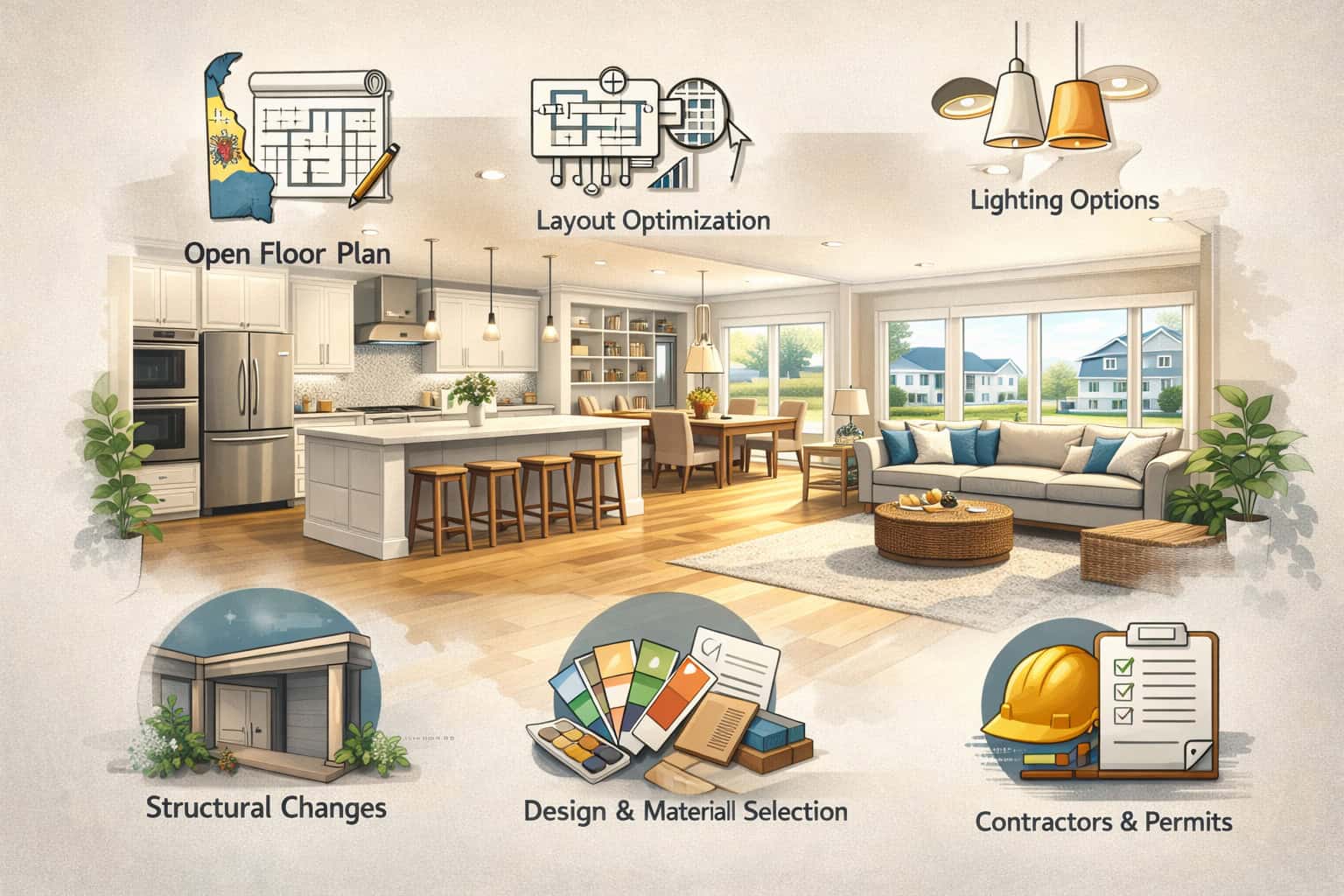
Open Floor Plan Renovations in Delaware can make your home feel brighter, larger, and more functional—especially when you’re combining kitchen-dining-living open concept spaces for everyday life and entertaining.
But the “open concept” look often involves serious behind-the-walls work: load-bearing wall removal, beam installation (often a LVL beam), electrical rerouting, HVAC ductwork changes, and sometimes plumbing relocation.
In Delaware, success usually comes down to three things:
- Structural clarity: Confirm what’s load-bearing and plan the right beam/posts solution with a structural engineer Delaware homeowners trust.
- Local process: Understand the permit process Delaware jurisdictions expect, and plan for zoning and inspections (which vary by town/county).
- Livability + moisture realities: Coastal humidity in Sussex, older housing stock in Wilmington, and tight mechanical chases in many colonials and ranchers all affect design, scheduling, and budget.
This Delaware open concept renovation guide walks you step-by-step from early planning to final inspection—without sales fluff—and includes real-world cost/timeline ranges, decision frameworks, design ideas, common mistakes, and hiring guidance.
What “Open Concept” Really Means in Delaware Homes
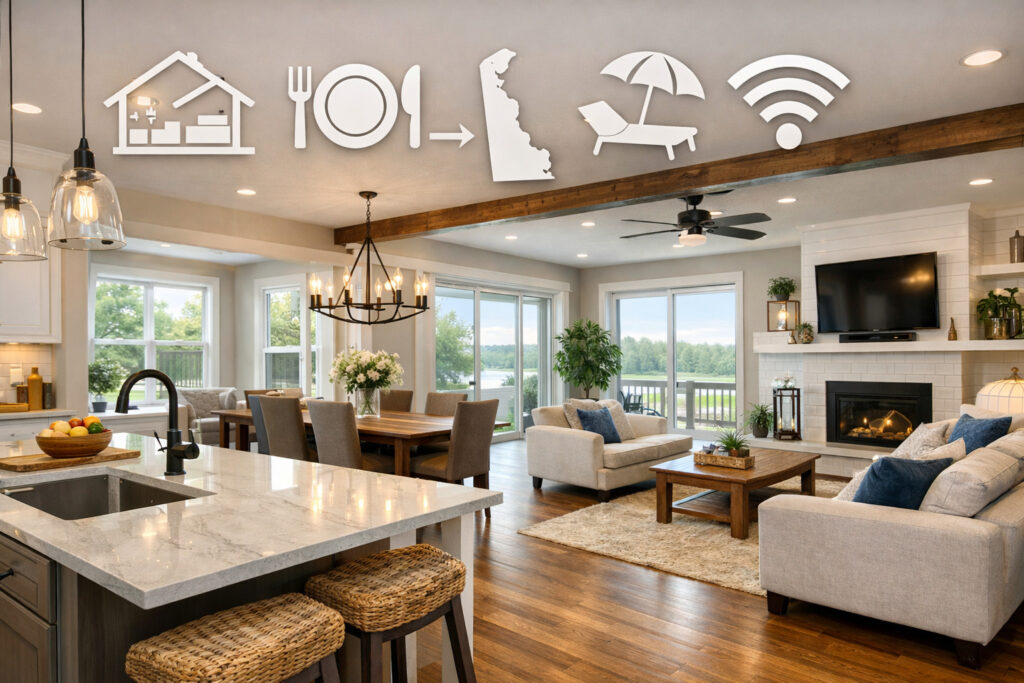
An “open floor plan remodel Delaware” homeowners envision is usually a rebalancing of three zones—kitchen, dining, and living—so they flow as one space without feeling like a hallway with furniture.
In real houses across New Castle County, Kent County, and Sussex County, that typically means removing or modifying at least one interior wall and then redesigning how the home functions: where people enter, where coats land, where the TV wall goes, where dining actually fits, and how cooking smells and sound behave.
Delaware has a mix of home types that shape what’s realistic. In a rancher open floor plan, you may have a straightforward roof structure but limited attic space for rerouting ductwork.
In classic colonial layout changes, the wall between kitchen and dining is sometimes structural, sometimes not—but it frequently contains wiring, plumbing vents, or HVAC returns.
In a historic Wilmington home, walls may be thick, framing may be inconsistent compared to newer builds, and you might run into older electrical conditions that make “just moving a light” into a bigger scope.
Open Floor Plan Renovations in Delaware also have a “comfort” side that doesn’t show in photos: managing echoes, keeping the kitchen from dominating the whole space, and ensuring heating/cooling stays even once walls disappear.
The goal isn’t only openness—it’s a better function. When done well, you get clearer sightlines, safer circulation, and a home that supports real life (kids, pets, guests, work-from-home) without feeling like you live in one giant room.
The Delaware Reality Check: Why Costs and Complexity Vary So Much
Two Delaware homes can look similar on the outside and be wildly different on the inside. One reason is era: a 1990s home in Middletown may have engineered floor systems and predictable framing; a 1920s row-style or twin in Wilmington can have old repairs, mixed materials, and surprises behind plaster.
Another reason is county-by-county permitting culture and inspection expectations: the permit process Delaware municipalities follow can feel straightforward in some areas and more documentation-heavy in others. That’s not good or bad—it’s just something to plan around early.
Coastal conditions are another factor. A coastal Sussex home renovation often includes moisture-related considerations—humid air, salt exposure near the beach, and the way HVAC has to work harder in peak seasons.
When you open up a floor plan, you change air movement. That can be great (better circulation) or frustrating (hot/cold spots) if returns and supplies aren’t adjusted.
Finally, “open concept” usually triggers a chain reaction. You remove one wall… then you realize the lighting is wrong, the flooring transition looks chopped up, the old soffit hides ducts you now see, and the kitchen needs more storage because everyone can see it.
A practical way to think about scope is: structural + mechanical + finishes + lifestyle upgrades. That framing helps you budget, plan a realistic renovation timeline, and avoid the “we’ll figure it out later” trap that drives delays and change orders.
Step 1: Define Your Goals, Non-Negotiables, and Deal-Breakers

Before you sketch layouts or start calling contractors, clarify what “open” is supposed to solve. Most Delaware homeowners start with “more space,” but the projects that feel best afterward have specific functional wins, like: a safer cooking zone with better sightlines to kids, a dining area that finally fits, or a clear path from garage entry to pantry without cutting through the living room.
Start with three lists:
- Goals (what you want): brighter kitchen, island seating, better flow, more storage, better hosting.
- Non-negotiables (must keep): a fireplace wall, a dedicated homework spot, a formal dining table, a mudroom drop zone.
- Deal-breakers (what you don’t want): kitchen mess visible from the front door, TV above the fireplace, losing too much wall space, echoey “warehouse” feel.
Now add Delaware-specific lifestyle notes. In Sussex beach areas, you may want a “sand-and-sunscreen” buffer—durable floors and a rinse/landing zone.
In older Wilmington neighborhoods, you may value keeping some separation so the home still feels like itself (and to keep cooking noise/smell manageable in tighter footprints). In Kent County ranchers, you may prioritize simple, one-level circulation and accessibility.
Then decide how open you truly want to go. Some homeowners want a fully open kitchen-dining-living open concept. Others want “visually open but acoustically calmer,” using partial walls, columns, ceiling beams, or wide cased openings.
The best open floor plan remodel Delaware projects often choose a controlled openness that respects furniture placement and storage.
A Simple Decision Framework for “How Open Should We Go?”
If you’re stuck between options, use this framework. Rate each item 1–5 (5 = very important):
- Sightlines: Do you want to see the whole main level from the kitchen?
- Noise tolerance: Can you handle dishwasher/hood/TV noise in one shared space?
- Cooking intensity: Do you cook daily and sear/fry often?
- Storage needs: Do you need more wall space for cabinets, art, or furniture?
- Hosting style: Do people gather in the kitchen or do you prefer a separate dining zone?
- Resale flexibility: Do you want a layout that works for many future buyers?
If noise tolerance is low or cooking intensity is high, full open concept may frustrate you unless you plan strong ventilation, smart acoustics, and a clean storage strategy.
If storage needs are high, you may prefer wide openings rather than total wall removal so you keep some “anchor” walls for cabinetry or furniture. This is also where insulation and soundproofing strategies matter: open plans can be quieter than you’d think—if you plan for it.
Once you’re aligned at the “why” level, you’ll make better layout choices, control costs, and reduce mid-project second guessing.
Step 2: Evaluate Your Existing Layout and Home Style

Your home’s structure and mechanical routes dictate what’s feasible without turning the project into a full gut renovation. Start with a walkthrough and a “map the pain” exercise. Note where traffic jams happen, where doors conflict, where the fridge blocks a path, and where you always wish for one more outlet.
Common Delaware scenarios include:
- Colonials in New Castle County: often have a kitchen tucked behind dining/living with a wall or cased opening; stair placement can limit where an island can go.
- Ranchers in Kent County: sometimes have smaller, segmented rooms; opening can be simpler structurally but harder mechanically if ducts run through soffits.
- Split-levels: can be tricky because beams and bearing points often align with level changes.
- Historic Wilmington home layouts: charming but compartmentalized; plaster walls and older framing can hide surprises.
- Sussex coastal homes: may already be partially open but need better ventilation, moisture control, and durable finishes.
Measure key dimensions that drive design:
- Distance from sink to range to fridge (kitchen work triangle, or a modern “work zone” version).
- Clearances around where an island might go.
- Window/door locations that limit cabinet runs.
- Ceiling heights and soffits (often hiding HVAC ductwork or beams).
Also evaluate what you’ll lose when walls come down. Walls aren’t only separators—they hold switches, outlets, returns, and sometimes plumbing vents. In many open concept plans, the “new” wall you miss most is a place for a buffet, a bookcase, or a TV. Plan where those functions go before demolition.
If you can, take photos of each wall from multiple angles and mark them with notes: “switch,” “return,” “duct,” “thermostat,” “plumbing.” This becomes incredibly useful when you start talking to designers, contractors, and—if needed—your structural engineer.
How to Spot Constraints That Affect Layout Options
Even before you confirm structural details, you can identify likely constraints that shape design:
- Soffits over cabinets: often conceal HVAC ductwork; removing them may require rerouting ducts (budget + time).
- Floor registers/returns: open plans sometimes need new return strategies to avoid hot/cold zones.
- Ceiling joist direction: a clue (not proof) about what might be load-bearing.
- Plumbing “wet walls”: kitchens and bathrooms often stack plumbing; moving sinks can trigger bigger plumbing relocation.
- Fireplaces/chimneys: can anchor a layout but limit openness.
Treat these as “design gravity.” You can work against gravity—but it costs more, takes longer, and increases risk. The sweet spot for Open Floor Plan Renovations in Delaware is often a layout that feels dramatically better while respecting the home’s existing logic.
Step 3: Load-Bearing Walls and Structural Planning

This is the section most homeowners wish they read earlier. A load-bearing wall isn’t “a wall that feels sturdy.” It’s a wall that carries weight from above—roof, ceiling, upper floors—and transfers it down to the foundation.
When you remove it, you must replace its structural function with an engineered solution (typically a beam, and often posts down to a bearing point).
Because Delaware homes span many eras and building methods, you should not assume based on rules of thumb. A wall that looks “interior” can be load-bearing. A wall with a big opening can still be carrying load via a header. And in older homes, structural behavior can be different than you expect.
In an open floor plan remodel Delaware project, the common structural path is:
- Confirm what’s load-bearing (or partially bearing).
- Engage a structural engineer Delaware homeowners trust (or the contractor’s engineer, if you verify independence and credentials).
- Design the beam and any posts/footings required.
- Coordinate the structural plan with electrical rerouting, HVAC ductwork, and finishes.
- Pull permits and schedule inspections appropriate to your jurisdiction.
Typical solutions include beam installation using a steel beam or an engineered wood beam like an LVL beam. Sometimes the beam can be concealed in the ceiling (requires opening framing and may impact ceiling height or require reframing).
Sometimes it sits below the ceiling line as a “dropped beam,” which can be turned into a design feature if planned well.
How to Identify a Load-Bearing Wall and Why You Must Consult a Structural Engineer
You can gather clues, but you shouldn’t make final calls without a pro. Helpful clues include:
- The wall runs perpendicular to ceiling joists (often bearing, but not always).
- The wall aligns with beams or supports in the basement/crawlspace.
- The wall sits under an upper-floor wall in a two-story colonial.
- The wall is near stair openings (often structurally significant).
- The wall contains a large header over a wide opening.
But here’s the practical reason to consult a structural engineer: once you open a wall, you may discover surprises—double top plates, sistered joists, hidden beams, uneven framing. The engineer’s job is to translate the actual structure into a safe, buildable plan.
They also help your contractor coordinate temporary support (shoring), beam sizing, post locations, and bearing points.
If your project involves removing or widening a wall, assume inspections may look for: correct beam size/type, proper fastening, approved post locations, and adequate load transfer down to a bearing point.
If new footings are required, that’s another inspection layer. Always confirm with your local building department what they expect, and keep documentation organized so you’re not scrambling mid-project.
Step 4: Permits, Zoning, and Inspections in Delaware
The permit process Delaware homeowners experience isn’t one-size-fits-all. Requirements can vary by municipality and county, and even within a county depending on whether you’re in an incorporated town/city or an unincorporated area.
The safe, practical approach is to assume that structural changes, significant electrical work, plumbing relocation, and HVAC modifications will require permits and inspections—and then confirm specifics with your local building department early.
What often triggers permits in Open Floor Plan Renovations in Delaware:
- Load-bearing wall removal or structural modifications
- New beams/posts/footings
- Significant electrical changes (new circuits, panel work, major rerouting)
- Moving plumbing (sink, dishwasher, gas lines if applicable)
- HVAC ductwork changes that affect system performance or safety
- Alterations that affect egress, stairs, or fire safety features
A homeowner-friendly way to manage this: ask for a “permit matrix” from your contractor or designer—one page listing what trades are involved, what permits are expected, and what inspections are typical. Even if your contractor handles the paperwork, you want visibility so you can plan the schedule and avoid delays.
Also remember: inspections are not the enemy. They’re a checkpoint to catch problems before drywall and finishes hide them. It’s much easier to fix a questionable beam connection or an overloaded circuit during rough-in than after you’ve installed cabinets and flooring.
Delaware homeowners in older neighborhoods (like parts of Wilmington) should also factor in potential historic district or older-home considerations. You don’t need to panic—just treat early confirmation as part of planning, not a last-minute scramble.
A Practical Checklist for Navigating the Local Process
Use this checklist as a calm, methodical way to handle the local process:
- Identify your jurisdiction (county + municipality).
- Call or check your local building department website for:
- Whether your scope needs permits
- Required drawings (architectural, structural)
- Whether a stamped engineer plan is needed for load-bearing changes
- Inspection stages (demo/structural, rough electrical, rough plumbing, rough HVAC, insulation, final)
- Ask about typical review timelines and scheduling lead times for inspections.
- Confirm who is pulling permits (you or contractor) and whose name they’re in.
- Keep a project folder with: engineer drawings, product specs for beams, contractor license/insurance, and permit documents.
This Delaware open concept renovation guide can’t promise the exact steps for every town, so the best practice is simple: verify locally, document decisions, and build inspection lead time into your renovation timeline. That one habit prevents the “everything is ready but we can’t close walls for two weeks” problem.
Step 5: Budget Ranges and What Drives Cost in Delaware
Let’s talk numbers—carefully. Renovation pricing can swing dramatically based on structure, mechanical complexity, finish level, and how many “while we’re at it” upgrades you add. But most homeowners want realistic ranges so they can decide whether to proceed and how to phase work.
For Open Floor Plan Renovations in Delaware, a common way to budget is to split costs into five buckets:
- Structural work (engineering, demo, shoring, beam/posts/footings)
- Mechanical updates (electrical rerouting, HVAC ductwork, plumbing relocation)
- Finishes (drywall, paint, flooring transitions, trim)
- Kitchen changes (if included: cabinets, island seating, countertops, appliances)
- Project management + contingency
Typical budget ranges (very general):
- “Wall removal + finish repair” (one wall, minor rerouting, minimal kitchen changes): $15,000–$40,000
- “Open main level + lighting/flooring continuity” (multiple openings, recessed lighting plan, flooring transitions, some HVAC/electrical changes): $40,000–$90,000
- “Full kitchen-dining-living open concept” (structural + major mechanical + new kitchen layout and island): $90,000–$200,000+
What drives the top end:
- Load-bearing complexity (beam size, posts, footings)
- How far you move plumbing and gas (if applicable)
- HVAC redesign vs minor duct tweaks
- Electrical panel limitations (new circuits, upgrades)
- Finish scope (continuous flooring, custom trim, ceiling work)
- Coastal moisture upgrades (better ventilation, materials)
- Older-home surprises (wiring, framing repairs, leveling)
A renovation budget Delaware homeowners can stick to usually includes a 10–20% contingency. In older Wilmington homes or projects with major structural/mechanical changes, 20% is more comfortable. Contingency isn’t “extra spending money”—it’s protection against hidden conditions and necessary adjustments.
How to Build a Budget That Matches Your Priorities
Instead of guessing, build your budget backwards from priorities:
- Decide your “must-have” list (ex: safe wall removal + island seating + better lighting).
- Decide your “nice-to-have” list (ex: ceiling treatments, built-in storage, premium flooring).
- Assign rough ranges to each bucket:
- Structural + engineering: often $5,000–$30,000+
- Electrical/lighting: often $3,000–$20,000+
- HVAC adjustments: often $2,000–$15,000+
- Plumbing relocation: often $1,500–$10,000+
- Drywall/paint: often $3,000–$15,000+
- Flooring transitions or new floors: often $5,000–$40,000+ depending on area/material
Then pressure-test your plan: if you cut 15% tomorrow, what changes without damaging the result? Often you can delay decorative upgrades, but you shouldn’t cut structural correctness, ventilation, or core electrical safety.
The goal is to spend where it actually improves daily living—and to avoid the trap of spending big money only to end up with awkward furniture placement, poor lighting, and a noisy echo chamber.
Step 6: Timeline Ranges and How Renovations Actually Unfold
A realistic renovation timeline helps you plan life: childcare, pets, work-from-home, cooking, and whether you can live in the house. Timelines vary, but many open concept projects follow a recognizable arc.
Typical timeline ranges (very general):
- Planning + design + bids: 3–10 weeks
- Engineering + permit approvals: 2–8+ weeks (depends on jurisdiction and workload)
- Construction:
- Small opening + finishes: 2–6 weeks
- Larger structural + mechanical + finishes: 6–14 weeks
- Full open concept with kitchen rebuild: 10–20+ weeks
The biggest timeline killers are (1) waiting on decisions, (2) changing orders mid-stream, and (3) inspection or trade scheduling bottlenecks.
If you want the project to move smoothly, make critical decisions early: final layout, island dimensions, lighting locations, flooring approach, and appliance specs. Your contractor can’t rough-in electrical for a recessed lighting plan that doesn’t exist yet.
Also plan for “hidden time.” Dust control setup, protection of floors, daily cleanup, and coordination between trades aren’t optional—they’re time-consuming and essential.
In coastal Sussex areas, humidity can also affect drying times for certain materials and finishes; your contractor will plan around this, but it can still add a little variability.
If you’re living through renovation, assume some weeks will feel slow and messy. That’s normal. The key is to maintain momentum through pre-decisions and clear communication, not by rushing craftsmanship.
Living Through Renovation: A Delaware Homeowner Survival Plan
Living through renovation can be manageable if you plan like you’re going on a small expedition. Use these strategies:
- Set up a temporary kitchen zone: microwave, toaster oven, coffee, dish tub, and a dedicated shelf for essentials.
- Choose a “clean room” (often a bedroom) where construction dust is minimized.
- Confirm dust control methods: plastic barriers, negative air machines, floor protection, daily cleanup.
- Plan for noise: heavy demo days, saw work, and sanding days may require you to work elsewhere.
- Protect HVAC: discuss how vents/returns will be handled to reduce dust circulation.
- Create a pet and kid safety plan: gates, closed doors, clear “no-go” zones.
Also plan decision time. You’ll be asked questions quickly during framing and rough-in. If you’re not ready, the project either pauses or decisions get made under pressure.
A calm approach is to schedule a weekly 20-minute “decision meeting” with your contractor to preview what’s coming next—lighting placement, outlet locations, and any surprises uncovered behind walls.
Step 7: Mechanical Changes You Should Expect
When you open a space, you’re not just removing drywall—you’re reworking the home’s nervous system. Most open floor plan remodel Delaware projects include at least some of the following: electrical rerouting, lighting redesign, HVAC ductwork adjustments, and occasionally plumbing relocation.
Electrical is usually the most visible change. Switches that were on a wall you removed must move. You may also want a more thoughtful lighting plan: layered lighting with recessed lights, pendants over an island, and under-cabinet lighting if the kitchen is part of the open area. Open plans also often expose “weird” outlet placement—like one lonely outlet that used to serve a dining room wall.
HVAC is often the most underestimated. Walls sometimes hide returns or act as boundaries that help air distribute. When you remove them, you can end up with a large volume that’s harder to heat/cool evenly, especially in older homes with less insulation.
Coastal Sussex humidity can compound this—comfort isn’t only temperature; it’s moisture control. Good contractors plan supply/return balance, and sometimes recommend zoning adjustments depending on your home’s layout.
Plumbing relocation may come into play if your sink moves, you add an island sink, or your dishwasher location shifts. Islands also create planning needs for power—outlets and code-compliant placement (confirm local requirements). All of this is doable; it just needs to be coordinated early so you don’t rip open new work later.
Lighting, HVAC, and Electrical: A Coordination Checklist
Use this checklist to avoid the “we didn’t think of that” moments:
- Finalize the furniture plan early (TV wall, dining table size, seating layout).
- Create a recessed lighting plan that matches zones (kitchen task, dining ambient, living accent).
- Decide on island seating orientation and pendant count/spacing.
- Plan switches so you can enter and control key zones logically.
- Confirm where returns are now and what happens when walls are removed.
- Ask how ductwork will be rerouted if soffits are removed.
- Confirm hood ventilation strategy if the kitchen is central (especially important in open plans).
- Identify any floor registers that may end up under an island or in odd locations after the layout changes.
A well-coordinated mechanical plan makes the finished space feel intentional—quiet, comfortable, and easy to live in. A poorly coordinated plan is what causes flickery lighting, dead outlets, and the “why is the living room always cold” problem.
Step 8: Design Ideas That Actually Work in Real Delaware Homes
Design isn’t just aesthetics—it’s how your day flows. The best Open Floor Plan Renovations in Delaware make the home easier to live in without turning it into a showpiece you’re afraid to use. Start by choosing a layout strategy that fits your footprint:
- Big opening + defined zones: keep a partial wall or wide cased opening; gives openness while preserving wall space.
- Full open with an island anchor: works well when you have enough width for safe clearances.
- Kitchen-forward vs living-forward: decide whether the kitchen is the “main stage” or a support zone.
- Add a pantry wall or tall cabinet run: replaces lost storage from removed walls.
Kitchen island sizing is one of the most common regret areas. People build an island that looks great on paper but feels tight in real life. Prioritize clearances around it and the path from entry to kitchen. Island seating should feel comfortable, not like stools are blocking traffic.
Lighting is where open plans either shine or feel flat. Layered lighting matters: recessed lights for general illumination, pendants for personality and task light, and accent lighting to prevent the “big bright box” effect.
Flooring continuity also makes a huge difference. A single continuous floor can visually unify the space, but it isn’t always required. If you keep different materials, plan clean transitions that look intentional—especially in older homes where subfloor heights may vary.
Ceiling treatments can add warmth and help define zones: subtle beams, a coffer detail, or even a simple paint shift can break up the expanse.
Acoustics, Privacy, and Storage: The Open Plan Trifecta
Open concept living is often criticized for noise and lack of privacy—but you can plan around that:
- Acoustics: add soft surfaces (rugs, upholstered furniture, drapes); consider insulation and soundproofing in key walls/ceilings during the renovation; choose quieter appliances.
- Privacy: use partial walls, columns, furniture placement, or a “buffer” entry zone so you’re not staring into the kitchen from the front door.
- Storage: plan closed storage (pantry, tall cabinets, built-ins) so daily clutter doesn’t become permanent decor.
If you’re opening up a historic Wilmington home, consider preserving one strong architectural element—an archway, built-in, or trim detail—so the space feels cohesive with the home’s character.
In a coastal Sussex home renovation, prioritize materials and finishes that handle moisture and sandy traffic: durable flooring, easy-clean paint, and a ventilation strategy that keeps humidity from making the open space feel sticky in summer.
Step 9: Flooring Transitions, Ceilings, and Finish Work
Finish work is where open concept renovations either look seamless or look like a patchwork of “before and after.” When walls come down, you often have to patch floors, align ceiling planes, and deal with trim continuity. In older homes, you might discover that floors were installed at different times or heights, which affects how smooth the transition can be.
Flooring transitions deserve early planning, not end-of-project improvisation. If you’re keeping existing hardwood, match species and finish as closely as possible—but understand that perfect matches are rare, especially if sunlight has aged the original floor.
Sometimes a strategic refinish of a larger area is more cost-effective than trying to “surgically” patch a section that will always show.
Ceilings are another big moment. Removing a wall can reveal a ceiling seam, a soffit, or uneven surfaces. If you’re installing a dropped beam, decide whether it becomes a design feature or disappears into the ceiling with drywall work (more labor, more cost). If you want recessed lighting, coordinate it with framing and beam placement so you don’t end up with odd light spacing.
Trim and paint also matter more in open plans because you can see more surfaces at once. A clean, consistent trim strategy and thoughtful paint sheen choices help the space feel intentional—and easier to maintain when the kitchen is always visible.
Dust Control and Quality Control: What Homeowners Should Watch For
Finish phases can generate the most dust—drywall sanding, floor sanding, cutting trim. If you’re living through renovation, dust control is a quality issue as much as a comfort issue. Ask about:
- Plastic barriers and sealed doorways
- Floor protection and tack mats
- Negative air machines or air scrubbers (if used)
- Daily cleanup expectations
- How HVAC returns will be protected during dusty work
Also keep an eye on “fit and finish” checkpoints:
- Are flooring transitions flush and safe?
- Are ceiling patches smooth under raking light?
- Is lighting aligned with key sightlines (island, dining table, sofa)?
- Do doors swing without conflicts now that circulation has changed?
- Are outlets/switches placed logically for daily use?
This is where a short punch-list walk-through with your contractor before final payment protects you. Open concept spaces are unforgiving: small misalignments show more because you can see across the whole area. Catching them before finals is easier for everyone.
Step 10: Accessibility and Aging-in-Place in an Open Concept Remodel
An open plan can be a huge win for accessibility—if you plan it intentionally. Wider, clearer pathways reduce trip hazards and make daily life easier for kids, older adults, and anyone with mobility needs. But openness alone doesn’t guarantee comfort. You want a space that’s easy to navigate, easy to light, and flexible over time.
Key aging-in-place considerations for Open Floor Plan Renovations in Delaware:
- Clear circulation: avoid tight pinch points around islands and furniture.
- Non-slip flooring: especially important in coastal Sussex homes where wet feet and sand are common.
- Smart lighting: bright, even illumination with easy controls (dimmers, 3-way switches, or smart switches).
- Outlet planning: more outlets reduces cords (a real trip hazard).
- Threshold management: minimize raised transitions between materials.
- Seating and rest points: island seating can be great, but ensure there’s also comfortable dining seating for longer meals.
Kitchen design matters a lot here. Consider drawer bases over deep lower cabinets (easier access), pull-out trash, and a pantry system that reduces bending and reaching. If you’re reworking the kitchen layout, think about appliance placement so you’re not walking across the room carrying hot items.
Open plans also allow for future flexibility—like adding a small desk zone, a reading nook, or a main-level sleeping arrangement in some homes. If your remodel is partly motivated by long-term comfort, say that early to your designer/contractor so the layout supports it.
Safer Clearances and Island Seating That Won’t Become a Bottleneck
Island seating is a highlight in many open floor plan remodel Delaware projects—but it can also create a traffic jam if clearances are tight. Plan for:
- A clear main path that doesn’t run through the “stool zone.”
- Space so someone can sit while someone else walks behind them.
- Rounded corners or softened edges if kids are in the house.
- A landing area near the fridge and oven so cooking doesn’t collide with seating.
Also consider sightlines and glare for aging eyes: avoid placing seating where pendant lights shine directly into faces, and plan window treatments so you’re not battling harsh afternoon glare in a now-larger space. These details sound small, but they’re the difference between a kitchen that photographs well and a home that feels comfortable every day.
Step 11: Hiring Pros in Delaware: Contractor Selection, Engineers, and Red Flags
Hiring well is the fastest path to a smoother renovation timeline and fewer regrets. For many Open Floor Plan Renovations in Delaware, you’ll need some mix of: a general contractor, electrician, HVAC contractor, plumber, and—when structural work is involved—a structural engineer Delaware homeowners rely on.
Start by interviewing at least 3 contractors. You’re not just buying a price—you’re buying communication, planning skill, and the ability to coordinate trades.
Ask for examples of similar projects: load-bearing wall removal, beam installation, open kitchen conversions, older-home updates in Wilmington, or coastal Sussex work where moisture and materials mattered.
When you need a structural engineer:
- Removing or altering a load-bearing wall
- Enlarging openings significantly
- Adding a beam or posts
- Anything that changes load paths or involves footings
What to ask contractors:
- How do you confirm load-bearing vs non-bearing?
- Who provides engineering and drawings?
- What permits and inspections do you expect in my jurisdiction?
- How do you handle dust control and living-through-renovation?
- What’s your typical payment schedule?
- How do you handle change orders and scope shifts?
Red flags:
- “We don’t need permits for that.”
- Vague answers about structure (“We’ll figure it out when we open it.”)
- Unwillingness to put details in writing
- Pressure to decide immediately
- No clear plan for dust control or site safety
- Payment demands that are heavily front-loaded without clear milestones
A good contract should include scope, materials allowances (if any), change order process, schedule assumptions, payment milestones, and warranty basics. Keep it simple, clear, and written.
Contract Basics and Payment Schedules That Protect You and the Contractor
A fair payment schedule ties money to progress. While exact structures vary, look for milestone-based payments, such as:
- Deposit to secure scheduling and initial planning
- Payment after demo and rough framing/structural work
- Payment after rough inspections pass
- Payment after cabinets/major installs (if included)
- Final payment after punch list completion and final inspection (when applicable)
Make sure allowances are realistic if used (cabinets, lighting fixtures, tile). Unrealistic allowances create budget shock later. Also insist on a clear change order process: written description, cost, and timeline impact before the work happens. That one rule prevents “surprise invoices” and keeps trust intact.
Finally, verify insurance and licensing appropriate to the work. If your project touches multiple trades, make sure the contractor has a plan for coordinating them—because coordination is where open concept projects succeed or fail.
Step 12: Common Mistakes and How to Avoid Them
Open concept renovations are popular—and that means the mistakes are well-known. The good news: most are avoidable with planning and a little humility about what you don’t know yet.
Common mistakes Delaware homeowners make:
- Assuming a wall is non-load-bearing and starting demo without engineering.
- Underestimating mechanical work (electrical rerouting, HVAC ductwork, plumbing relocation).
- Designing an island that’s too big or placed in a major traffic path.
- Skipping a real lighting plan and ending up with shadows and glare.
- Ignoring acoustics and creating a loud, echoey space.
- Trying to patch floors invisibly when the existing floor has aged.
- Not planning storage and ending up with visible clutter in a now-open kitchen.
- Over-customizing for a photo trend rather than your daily routine.
- Not building contingency into the renovation budget Delaware homeowners need for surprises.
- Living through renovation without dust control and site safety rules.
How to avoid them:
- Bring in a structural engineer early when walls change.
- Create a scope map that includes structural, mechanical, and finishes.
- Mock the island with painter’s tape on the floor and “walk” the paths.
- Choose layered lighting and control zones with dimmers.
- Plan insulation and soundproofing where it matters, and use soft finishes.
- Decide early whether you’ll refinish larger floor areas for consistency.
- Add storage intentionally: pantry, tall cabinets, built-ins, drop zones.
- Keep your plan grounded in your routine (not just inspiration photos).
- Add 10–20% contingency based on home age and complexity.
- Treat dust control as part of the job, not an optional upgrade.
The “Change Order Spiral” and How to Stop It
One of the most expensive patterns is the change order spiral: demo reveals a surprise, decisions get rushed, scope expands, and suddenly the budget and schedule drift. You can prevent this by:
- Finalizing layout and key selections before construction begins.
- Holding a weekly check-in with your contractor focused on next-week decisions.
- Keeping a written “decision log” (lighting locations, fixtures, flooring transitions).
- Setting a rule: no change happens without written cost and schedule impact.
This keeps the project calm. Calm projects are faster, safer, and more enjoyable to live through. They also produce better craftsmanship because trades aren’t constantly redoing work. In a renovation, slowing down decisions early often speeds up the entire build.
Step 13: Putting It All Together—A Step-by-Step Project Roadmap
This section is your practical, reader-first roadmap for an open floor plan remodel Delaware homeowners can actually execute. Think of it as a checklist you can follow from first idea to final inspection.
Phase 1: Vision + feasibility (1–3 weeks)
- Clarify goals, non-negotiables, deal-breakers
- Rough budget range + contingency
- Walkthrough: note walls, switches, ducts, plumbing
- Identify likely constraints (soffits, returns, chimneys)
Phase 2: Design + scope definition (2–8 weeks)
- Create layout options (full open vs wide openings)
- Decide island approach and seating plan
- Draft a lighting plan and outlet strategy
- Determine flooring strategy (continuous vs transitions)
- Plan storage zones and entry “drop” space
- Get preliminary contractor input for feasibility
Phase 3: Structural + permitting (2–8+ weeks)
- Engage structural engineer if needed
- Finalize beam/posts plan (LVL beam or steel, as designed)
- Coordinate structural plan with HVAC/electrical/plumbing
- Confirm permit requirements; submit documents
- Plan inspection stages
Phase 4: Construction (6–20+ weeks depending on scope)
- Site protection + dust control setup
- Demo + temporary supports
- Structural modifications + beam installation
- Rough electrical rerouting + recessed lighting plan execution
- Rough HVAC ductwork adjustments
- Rough plumbing relocation if needed
- Rough inspections
- Insulation and soundproofing (where planned)
- Drywall + paint
- Flooring transitions or refinishing
- Trim and finish carpentry
- Fixture install + final electrical
- Final inspections and punch list
This roadmap keeps the project logical. When homeowners skip phases, they pay for it in stress and rework.
A Final Pre-Construction Checklist You’ll Be Glad You Used
Before demolition day, confirm:
- Your final layout is decided (no “we’ll see once it’s open”).
- Engineering is complete if walls are changing structurally.
- Permits are approved (or at least submitted with a plan).
- Lighting locations are marked and agreed upon.
- Flooring decisions are made, including transition details.
- Appliance specs are confirmed (especially hood ventilation needs).
- The dust control plan is documented.
- A living-through-renovation plan exists (temp kitchen, clean room, pet safety).
- Payment schedule and change order process are in writing.
If all of that feels like a lot, it is—but it’s also what separates a smooth renovation from a chaotic one. Open Floor Plan Renovations in Delaware are absolutely doable; they just reward preparation.
FAQ
Q.1: Do I always need a structural engineer for an open concept remodel?
Answer: Not always. If you are not altering any load-bearing walls and the changes are cosmetic (like widening a non-structural opening), you may not need an engineer. But if you’re removing or modifying a load-bearing wall—or you’re not 100% sure—consult a structural engineer Delaware homeowners trust. It’s the safest path and often required for permits.
Q.2: How do I know if a wall is load-bearing?
Answer: There are clues (joist direction, alignment with supports below, location under upper walls), but clues aren’t proof. The reliable approach is professional verification—especially before demolition. This is confirmed through inspection of framing, attic/basement alignment, and sometimes opening small areas to see structure.
Q.3: What’s the biggest hidden cost in open floor plan remodel projects?
Answer: Mechanical changes—especially HVAC ductwork and electrical rerouting—plus finish restoration like flooring patches and ceiling repairs. Structural work can be predictable once engineered, but “what’s inside the wall” often isn’t.
Q.4: Can I live in the house during the renovation?
Answer: Often yes, especially for smaller scopes, but it depends on how much of your kitchen is down and how extensive dust/noise will be. Many homeowners do live through renovation with careful dust control, a temporary kitchen setup, and clear safety rules.
Q.5: Do coastal Sussex homes need different materials or planning?
Answer: They often benefit from moisture-smart decisions: strong ventilation, durable flooring, and finishes that handle humidity and sandy traffic. Opening a floor plan can change airflow, so HVAC balance and dehumidification comfort matter.
Q.6: Will an open floor plan hurt resale?
Answer: It depends on execution. Most buyers like openness, but they also want functional zones, storage, and good lighting. Over-opening can reduce wall space and create awkward furniture layouts. “Controlled openness” often performs best long-term.
Q.7: How long does an open concept renovation take in Delaware?
Answer: It ranges widely. Planning/permits can take weeks to months, and construction can be a few weeks to several months depending on whether you’re doing structural changes, mechanical rerouting, and a full kitchen rebuild. Build in buffer time for inspections and trade scheduling.
Q.8: What should I ask a contractor before signing?
Answer: Ask about similar projects, engineering approach, permit handling, dust control, change orders, timeline assumptions, and payment milestones. Watch for red flags like dismissing permits or giving vague answers about structure.
Conclusion
Open Floor Plan Renovations in Delaware can be one of the most rewarding upgrades you make—when the project is guided by clear goals, solid structural planning, and realistic expectations about permits, mechanical changes, and finish work.
The “open concept” look is only the surface; the real success comes from coordinating load-bearing wall removal (with help from a structural engineer Delaware homeowners trust when needed), a thoughtful lighting and comfort plan, and details like flooring transitions, storage, and acoustics that make the space livable every day.
As you move forward, keep your decisions anchored in how you actually live—morning routines, hosting, work-from-home, kids, pets, and long-term comfort. Build a budget with a sensible contingency, plan a timeline that includes permit and inspection realities, and choose professionals who communicate clearly and document the process.
Done right, an open concept remodel doesn’t just “open up” rooms—it creates a main level that feels calmer, brighter, and more connected, whether you’re in a historic Wilmington home, a Kent County rancher, or a coastal Sussex retreat.