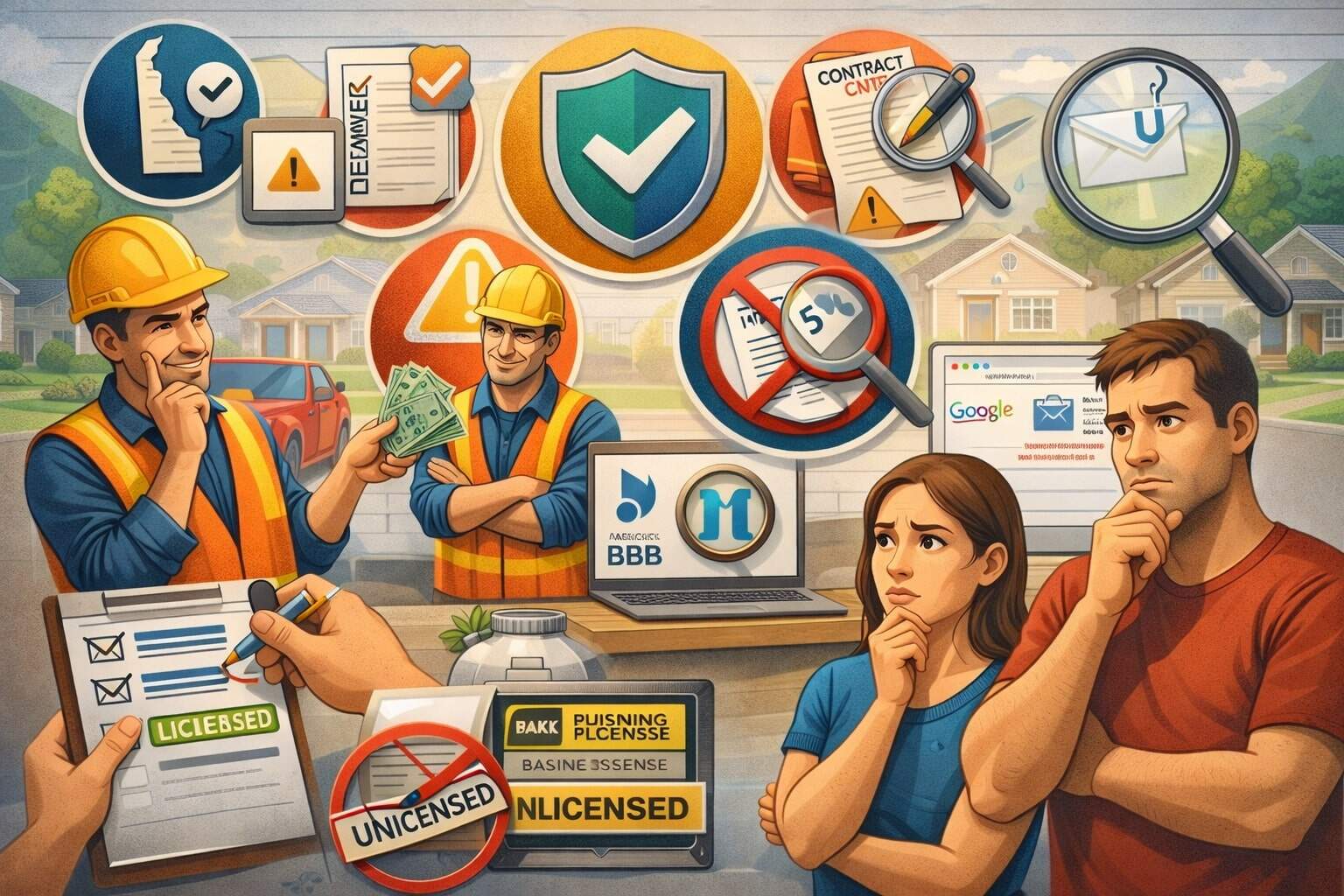
If you’re planning a remodel, roof repair, driveway project, or emergency fix, you’re also stepping into one of the biggest scam “opportunity zones”: home services.
The good news is that most problems are preventable when you know what to check, what to document, and what not to pay for up front. This guide is designed to help you avoid contractor scams in Delaware with practical, step-by-step actions you can use before you sign, while work is happening, and if something goes wrong.
Contractor fraud often follows a predictable script: pressure, vague promises, a rushed deposit, and then excuses, delays, or disappearing acts. The reason it works is simple—home repairs feel urgent and technical, and most homeowners don’t hire contractors often enough to spot red flags quickly.
To avoid contractor scams in Delaware, you don’t need to become a construction expert. You need a repeatable process: verify registration and licensing where required, demand a detailed written scope, control payments, insist on permits when applicable, and keep records that make it easy to enforce your rights.
Delaware has specific business registration and contractor registration expectations that matter when you’re hiring. Construction contractors performing “construction services” generally must register with the Department of Labor’s Office of Contractor Registration before work begins, and contractors doing business in the state are required to register and obtain a business license through the Division of Revenue.
Those checks alone won’t guarantee quality, but they dramatically reduce your risk when you’re trying to avoid contractor scams in Delaware.
Why Contractor Scams Happen So Often in Delaware
To avoid contractor scams in Delaware, it helps to understand why scams cluster around home improvement and repair jobs. The work is usually high-dollar, hard to price for a consumer, and often triggered by urgency: a leak, storm damage, a failed HVAC system, or a safety issue.
Scammers take advantage of that urgency by pushing you to “act now” and by offering a price that seems like a limited-time deal. The scam typically isn’t a single event—it’s a chain of decisions where the homeowner is steered away from documentation and toward trust-based, verbal promises.
Another reason scams flourish is that many legitimate contractors are busy. That supply-and-demand gap creates openings for unqualified operators who can start tomorrow. Some are not intentionally criminal but are undercapitalized: they take deposits from new jobs to pay old jobs, and projects spiral into delays and disputes.
Others are more direct—taking a deposit, doing a small amount of work to appear legitimate, and then disappearing. Either way, the homeowner is left trying to recover money with limited paperwork.
Delaware homeowners also face “license confusion.” Some trades require professional licensing (for example, plumbing/HVACR licensing is overseen by a state board), while general contracting may rely more on business licensing, registration, and local permitting.
Scammers exploit that confusion by claiming they’re “licensed” without specifying what they’re licensed for or by showing irrelevant credentials. If your goal is to avoid contractor scams in Delaware, your strategy is to remove ambiguity: verify what applies to your exact job, and write everything down.
Know the Most Common Contractor Scams in Delaware Before You Hire
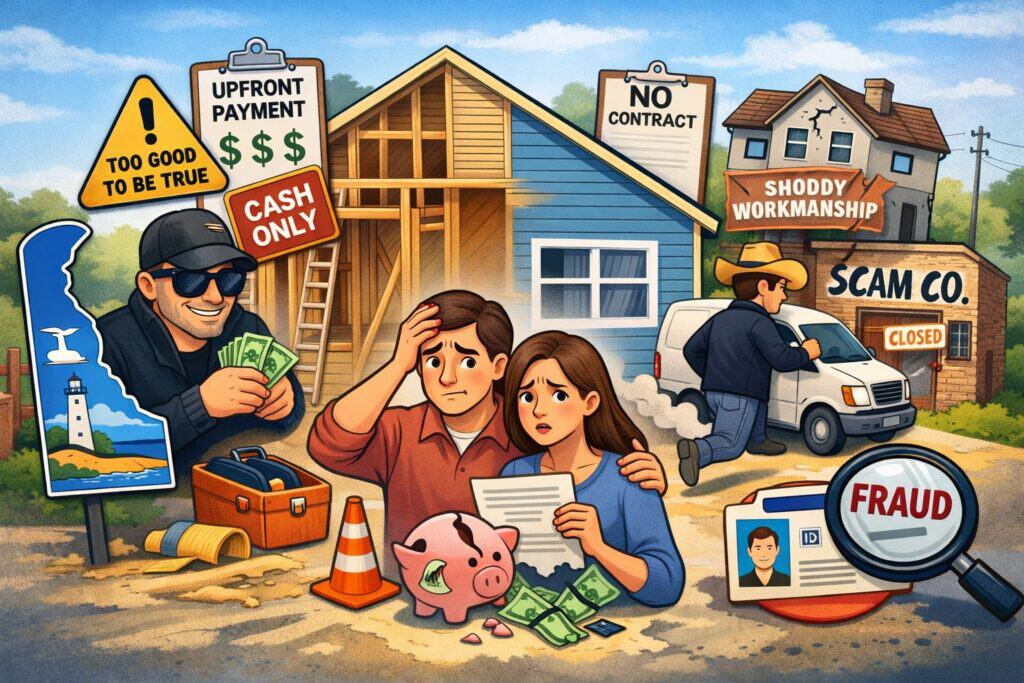
To avoid contractor scams in Delaware, you should recognize the patterns that show up repeatedly in consumer complaints nationwide and in state consumer protection work. These scams don’t always look like a dramatic “con.”
Sometimes they look like a friendly contractor who is “just too busy to write everything down.” That’s why naming the patterns matters—you’ll spot them faster.
The “Storm Chaser” and Door-to-Door Repair Pitch
After heavy wind, hail, or big rain events, you may see contractors offering same-day roof or siding repairs. The pitch often includes urgency (“your roof is leaking right now”), a promise to “handle everything,” and pressure to sign paperwork immediately.
Some door-to-door crews are legitimate, but this is a high-risk channel because the seller may not be the person doing the work, the business may be out-of-area, and the paperwork may be designed to lock you in. A common trick is getting a signature on an “inspection authorization” that functions like a contract or assignment.
To avoid contractor scams in Delaware in storm situations, slow the process down. Get the full legal business name, physical address, and written scope. Verify the contractor’s Delaware business license and whether they’re registered for construction services before work begins.
Then compare at least two quotes with similar scopes. If someone refuses to leave documentation behind, that refusal is your warning sign. Also watch for “leftover materials” stories—scammers use that to justify a too-good-to-be-true price while avoiding formal estimating.
The “Big Deposit Then Disappear” Scam
This is one of the oldest tricks and still one of the most common. The contractor requests a large deposit (sometimes 50–80%) to “buy materials.” Work begins slowly or not at all, and then the contractor stops returning calls. The homeowner is left with an unfinished project and little leverage.
To avoid contractor scams in Delaware, treat large deposits as a risk signal. A fair deposit can be reasonable for special-order materials, but it should be tied to documented purchasing and a clear schedule.
Use a payment plan based on milestones you can see (deliveries on site, demolition completed, rough-in passed, etc.). A legitimate contractor should be able to explain how they fund labor and why your deposit amount is justified. If the answer is vague, you’re not just trying to avoid contractor scams in Delaware—you’re trying to avoid becoming their financing source.
Verify the Contractor the Right Way in Delaware

Most homeowners do “verification” the wrong way: they check reviews, maybe glance at a website, and then proceed. Reviews can be manipulated, and websites can be created overnight.
To avoid contractor scams in Delaware, verification should be layered: business licensing, contractor registration, trade licensing (when relevant), insurance, and track record—each checked from a source the contractor can’t edit.
Confirm Delaware Business Licensing and Contractor Registration
Start with the basics: contractors conducting business activities in Delaware are required to register and obtain a business license from the Division of Revenue. In addition, Delaware law requires businesses performing “construction services” to be registered with the Delaware Department of Labor’s Office of Contractor Registration before work begins.
This matters because a scammer’s most common tactic is to operate under a rotating name, skip formal registration, and pressure customers to pay quickly.
When you’re trying to avoid contractor scams in Delaware, ask for the contractor’s business license information and proof of contractor registration (not just a verbal claim). Match the name on paperwork with the name on the business license/registration.
If they say “that’s my partner’s company” or “we use a different name for billing,” pause. Identity mismatch is a major red flag. Also confirm their physical address. A PO Box is not the same as an operating address.
Check Trade Licensing When the Work Requires It
Certain types of work—especially plumbing and HVACR—require proper licensure through Delaware’s professional licensing boards. For example, plumbing/HVACR licensing is overseen by the Delaware Board of Plumbing, Heating, Ventilation, Air Conditioning and Refrigeration (HVACR) Examiners.
For your project, you’re not just hiring “a contractor”—you may be hiring multiple licensed trades. If the general contractor says, “My guy is licensed,” require the license number and verify it.
To avoid contractor scams in Delaware, align the license to the task. A general contractor’s business license does not automatically mean the person installing gas piping is licensed for that work.
If licensing is required and the contractor can’t provide it, you risk unsafe work, failed inspections, and expensive rework. Verification is not “extra”; it’s a core tactic to avoid contractor scams in Delaware.
Use a Contract That Makes Scams Hard to Pull Off
A scam thrives in vagueness. The best way to avoid contractor scams in Delaware is to use a contract that removes wiggle room. A “one-page estimate” is not a contract. A text message is not a contract. A real contract is a tool: it defines what success looks like, how long it should take, what it costs, how changes work, and what happens if either side fails to perform.
What Your Delaware Contract Must Spell Out
To avoid contractor scams in Delaware, your agreement should include: the exact scope (materials, brands, model numbers where possible), start date and substantial completion date, cleanup and debris removal responsibilities, permit responsibility (who pulls permits), inspection checkpoints, and a payment schedule tied to visible milestones. Include warranty terms (labor and manufacturer), and the process for changing orders.
Require the contractor to list who will actually perform the work: employees vs. subcontractors. If subcontractors are used, the contract should require that they also comply with registration and licensing requirements that apply to their trade. This reduces the risk of “phantom subcontractors” being blamed for delays.
Also include documentation rules: daily photo updates, written approval for changes, and receipts for allowances. You’re not being difficult—you’re setting a standard that helps you avoid contractor scams in Delaware by making it harder for anyone to claim confusion later.
Change Orders: The #1 Place Homeowners Get Tricked
Many contractor disputes start with change orders. A scammy operator will bid low to win the job and then make profit through constant “unexpected” add-ons. To avoid contractor scams in Delaware, change orders should be written, priced, and signed before the work is done. No exceptions. If a contractor says, “We’ll settle up at the end,” you’re giving up your main control point.
Your change order process should require: description of the change, added/removed cost, added time, and any impact on warranty or permit scope. If you maintain discipline here, you will avoid contractor scams in Delaware that rely on emotional pressure mid-project.
Payment Rules That Protect You From Contractor Scams
If you want to avoid contractor scams in Delaware, payment control is one of the biggest levers you have. Scams often succeed because money moves faster than accountability. Once a contractor has most of the money, the homeowner’s leverage drops sharply. Your goal is not to “pay as little as possible.” Your goal is to pay in a way that matches progress and proof.
Smart Deposit Practices and Milestone Payments
A reasonable deposit can be acceptable, but it should never be your entire risk. To avoid contractor scams in Delaware, tie money to milestones you can verify: materials delivered to your property, demolition completed, framing complete, rough-ins completed, inspection passed, finish installed, punch list cleared. If a contractor insists on a massive upfront payment “to hold your spot,” consider that a red flag.
Whenever possible, pay in a traceable way. Avoid cash. Checks, cards, or bank transfers create a record trail. Save invoices, receipts, and payment confirmations. That paper trail becomes critical if you need mediation, legal action, or consumer protection help later.
Also require lien-related paperwork where appropriate. While lien law details can get technical, the principle is simple: you don’t want to pay the general contractor and later discover a subcontractor wasn’t paid.
Delaware mechanics’ lien law exists to protect parties who provide labor and materials, and lien claims are filed in the county where the job is located. The safest approach is to document payments and require proof that subs and suppliers are being paid as milestones are met.
Final Payment: Keep Leverage Until the End
To avoid contractor scams in Delaware, don’t release final payment until the job is truly complete: all contracted items installed, inspections passed where required, debris removed, and punch list finished.
Many homeowners pay the final amount when the job “looks mostly done,” and then struggle to get small but important fixes completed.
Use a walkthrough checklist. Photograph finished work. Confirm warranty documents and any manuals. If your contract includes “as-built” notes or product information, collect it before final payment.
Scammers hate structured closeout because it forces them to finish. This is how you avoid contractor scams in Delaware without constant conflict.
Permits, Inspections, and Local Rules: Your Hidden Anti-Scam Shield
Permits and inspections can feel like bureaucracy, but they’re also one of the best ways to avoid contractor scams in Delaware. Scammers often avoid permits because permits create records, require code compliance, and expose the work to third-party review.
If your project needs a permit and your contractor pushes you to skip it, that’s not “saving money.” That’s transferring risk to you.
How to Know When a Permit Is Needed
Permit requirements vary by local jurisdiction and project type. A contractor who works regularly in your area should know the basics and should be willing to pull permits when required. To avoid contractor scams in Delaware, ask early: “Will this job require a permit? Who will pull it? What inspections will happen?” The answers should be specific.
Even when a permit isn’t required, good contractors still follow code and manufacturer installation guidelines. Scammers often cut corners: improper flashing, undersized electrical work, unvented exhaust, or unsafe plumbing connections. If you think “it’s inside the walls so no one will notice,” that’s exactly the scammer’s profit model.
Inspections Create a Progress Timeline You Can Enforce
To avoid contractor scams in Delaware, use inspections as checkpoints. If your project includes electrical, plumbing, structural changes, or major mechanical work, inspections create a documented timeline. That timeline protects you in disputes and helps you enforce milestone payments.
Inspections also reduce “partial work” scams—where a contractor does enough to justify a payment request but not enough to meet code. When the inspector is involved, “almost done” becomes “pass/fail.” That’s powerful leverage and a practical way to avoid contractor scams in Delaware without needing construction expertise.
Recognize Red Flags During the Project (Not Just Before It Starts)
Many homeowners think scams only happen at signing. In reality, a lot of contractor scams develop mid-project, when you’re already committed and tired. To avoid contractor scams in Delaware, watch for behavioral red flags that signal risk escalation. These signs often appear weeks before a contractor disappears or demands extra money.
The Communication Breakdown Pattern
A common warning sign is a shift from proactive updates to excuses. You start hearing: “My truck broke down,” “My supplier messed up,” “My crew is out sick,” or “I’ll be there tomorrow,” repeated for days. Legitimate issues happen, but patterns matter. To avoid contractor scams in Delaware, require written weekly updates and insist that schedule changes be documented.
If your contractor won’t answer calls but suddenly replies fast when a payment is due, treat that as a serious concern. Ask for a revised schedule in writing. If they refuse, stop payments until the plan is clear. Scammers often rely on homeowners continuing to pay “to keep the project moving.” Your discipline is how you avoid contractor scams in Delaware.
Materials Substitution and “Missing Receipts”
Another mid-project scam is substitution: cheaper materials installed than what was quoted. To avoid contractor scams in Delaware, require material lists and keep packaging or take photos of labels as materials arrive. If a contractor says, “Trust me, it’s the same,” ask for the manufacturer spec sheet or invoice.
Missing receipts are also a red flag. If you pay for an allowance item (tile, fixtures, cabinets), you should see documentation. When receipts are “lost” repeatedly, it can indicate inflated costs or misused funds. A clean paper trail is one of the simplest ways to avoid contractor scams in Delaware.
What To Do If You Suspect a Contractor Scam in Delaware
If you think something is wrong, act early. Waiting often makes recovery harder. To avoid contractor scams in Delaware, you need a response plan that protects your home and your documentation at the same time. Your first goal is to stop financial bleeding. Your second goal is to preserve evidence.
Freeze Payments and Document Everything
If the contractor is missing deadlines, changing terms verbally, or demanding money without progress, pause payments immediately.
To avoid contractor scams in Delaware, communicate in writing (email or text) and keep it factual: what was agreed, what is missing, what you need next. Take photos and videos of the job site. Save all invoices, estimates, and messages.
If the contractor has materials on site, photograph them. If work is partially completed, document quality issues. If there’s damage, record it. This isn’t about starting a fight—it’s about making sure you can prove what happened if you need help from an attorney, mediation, or consumer protection.
File Complaints Through the Right Delaware Channels
Delaware provides a consumer complaint process through the Department of Justice’s Consumer Protection Unit, which handles consumer fraud and scams and may attempt informal mediation in many cases.
You can also use Delaware’s statewide complaints and reporting guide to find the right complaint path for your situation.
To avoid contractor scams in Delaware turning into a total loss, include complete documentation when you file: contract, proof of payments, timeline, photos, and the contractor’s business identifiers.
A complaint doesn’t guarantee immediate recovery, but it creates an official record, increases pressure on bad actors, and may connect you with dispute resolution pathways.
Future Predictions: How Contractor Scams in Delaware Are Likely to Evolve
To avoid contractor scams in Delaware going forward, you should also understand how scams are changing. The next wave is more digital, more polished, and harder to detect with “common sense” alone. Scammers increasingly use professional-looking websites, paid social ads, and fake local phone numbers.
They may even use AI-generated reviews, photos, and “before/after” galleries that aren’t their work. That means your future-proof defense is verification through official channels and strict documentation—not just online reputation.
Another trend is payment fraud: requests for instant transfers, “deposit links,” or bank-to-bank payments that are hard to reverse. To avoid contractor scams in Delaware, expect more contractors (good and bad) to request faster payment methods.
Your safest approach is to use traceable, documented payments and to refuse methods that remove your ability to dispute unauthorized charges.
You may also see more licensing and compliance emphasis across construction services as states address workplace fraud and contractor registration. Delaware already points contractors to the Contractor Registration Act and related requirements for construction services registration.
Over time, homeowners can expect more digital verification tools, but also more sophisticated impersonation attempts. The future-proof rule remains: verify directly, document aggressively, and pay based on proven progress. That’s how you avoid contractor scams in Delaware even as tactics evolve.
FAQs
Q.1: How can I avoid contractor scams in Delaware if I need an emergency repair?
Answer: To avoid contractor scams in Delaware during an emergency, your biggest risk is rushing. Even when water is leaking or heat is out, you can still run a fast but structured process.
First, stabilize the immediate hazard (shut off water, isolate power if needed, use temporary measures). Then hire for the emergency stabilization step as a short, limited-scope job with a written price. After that, get bids for the full repair.
Ask for proof of Delaware business licensing and contractor registration for construction services before work begins. Use traceable payment methods, avoid large deposits, and insist on photos of any hidden damage.
Emergency scams often rely on fear and confusion, so your defense is boundaries: “I’ll approve the next step after I see documentation.” This approach helps you avoid contractor scams in Delaware without delaying critical safety actions.
Q.2: What should I do if a contractor refuses to provide a written contract?
Answer: If someone refuses a written contract, treat it as a likely scam indicator. To avoid contractor scams in Delaware, you should not proceed based on verbal promises. A written agreement protects both parties and is standard practice for legitimate businesses.
If a contractor says, “We don’t do paperwork,” that usually means they don’t want accountability for scope, schedule, or quality.
Offer a simple solution: ask them to sign your written scope and payment milestones. If they still refuse, move on. It’s better to lose a week than to lose thousands. A contractor who won’t write things down is telling you, in advance, that disputes will be “your word versus theirs.” That is the opposite of how to avoid contractor scams in Delaware.
Q.3: How do I avoid contractor scams in Delaware when hiring for plumbing or HVAC work?
Answer: For plumbing or HVACR work, trade licensing matters more. To avoid contractor scams in Delaware, verify that the individual or company performing the plumbing/HVACR work is properly licensed through the relevant Delaware professional board system (plumbing/HVACR licensing is overseen by the Board of Plumbing, Heating, Ventilation, Air Conditioning and Refrigeration Examiners).
Also verify the contractor’s Delaware business license and applicable contractor registration expectations for construction services. Then lock down scope: equipment model numbers, warranty details, disposal of old equipment, and the commissioning/startup process.
Many HVAC scams involve oversized equipment, missing permits, or warranty problems due to improper installation. Documentation, license verification, and milestone payments are your best tools to avoid contractor scams in Delaware in these trades.
Q.4: Where can I report contractor scams in Delaware?
Answer: If you believe you’ve experienced fraud or deceptive practices, Delaware’s consumer complaint process can route issues through the Department of Justice’s Consumer Protection Unit, which enforces consumer protection statutes and also conducts informal mediation in many cases.
Delaware also provides a central “complaints and reporting” guide that helps direct consumers to appropriate channels.
To avoid contractor scams in Delaware becoming a long, unclear dispute, file with strong documentation: contract, proof of payments, photos, and a clear timeline. Keep your messages factual and organized.
Even if a complaint doesn’t instantly recover money, it builds a record and can support additional options like attorney review, small claims pathways (when appropriate), or insurance claims depending on the situation.
Q.5: How can I avoid contractor scams in Delaware if I’m worried about liens?
Answer: Liens can be confusing, but the practical risk is simple: you don’t want to pay once and then face claims that others weren’t paid. Delaware mechanics’ lien law provides a framework for parties supplying labor and materials, and lien claims are filed in the county where the property is located.
To avoid contractor scams in Delaware involving liens, use milestone payments and require documentation that supports progress. Ask who the major subcontractors and suppliers are. For large jobs, consider requesting lien-related paperwork at key milestones (and consult an attorney if the project is high-value).
Most importantly, don’t make final payment until the project is complete and you have documentation that reduces the risk of unpaid parties. This isn’t about distrusting everyone—it’s about building a process that helps you avoid contractor scams in Delaware even when multiple companies are involved.
Conclusion
To avoid contractor scams in Delaware, you don’t need perfect judgment—you need a system. Verify the contractor’s Delaware business license and confirm contractor registration requirements for construction services before work begins.
Verify trade licenses when the job requires it (especially plumbing/HVACR). Use a detailed written contract with milestone payments, written change orders, and clear closeout requirements. Treat permits and inspections as protection, not hassle. Pay in traceable ways and keep leverage until the punch list is complete.
If problems appear, act early: freeze payments, document everything, and use Delaware’s consumer complaint options when needed through the Department of Justice Consumer Protection process.
The future will bring more polished digital scams, but the defenses will stay the same: verify directly, write everything down, and pay based on proven progress. When you apply that process consistently, you will avoid contractor scams in Delaware with far less stress—and far better outcomes.