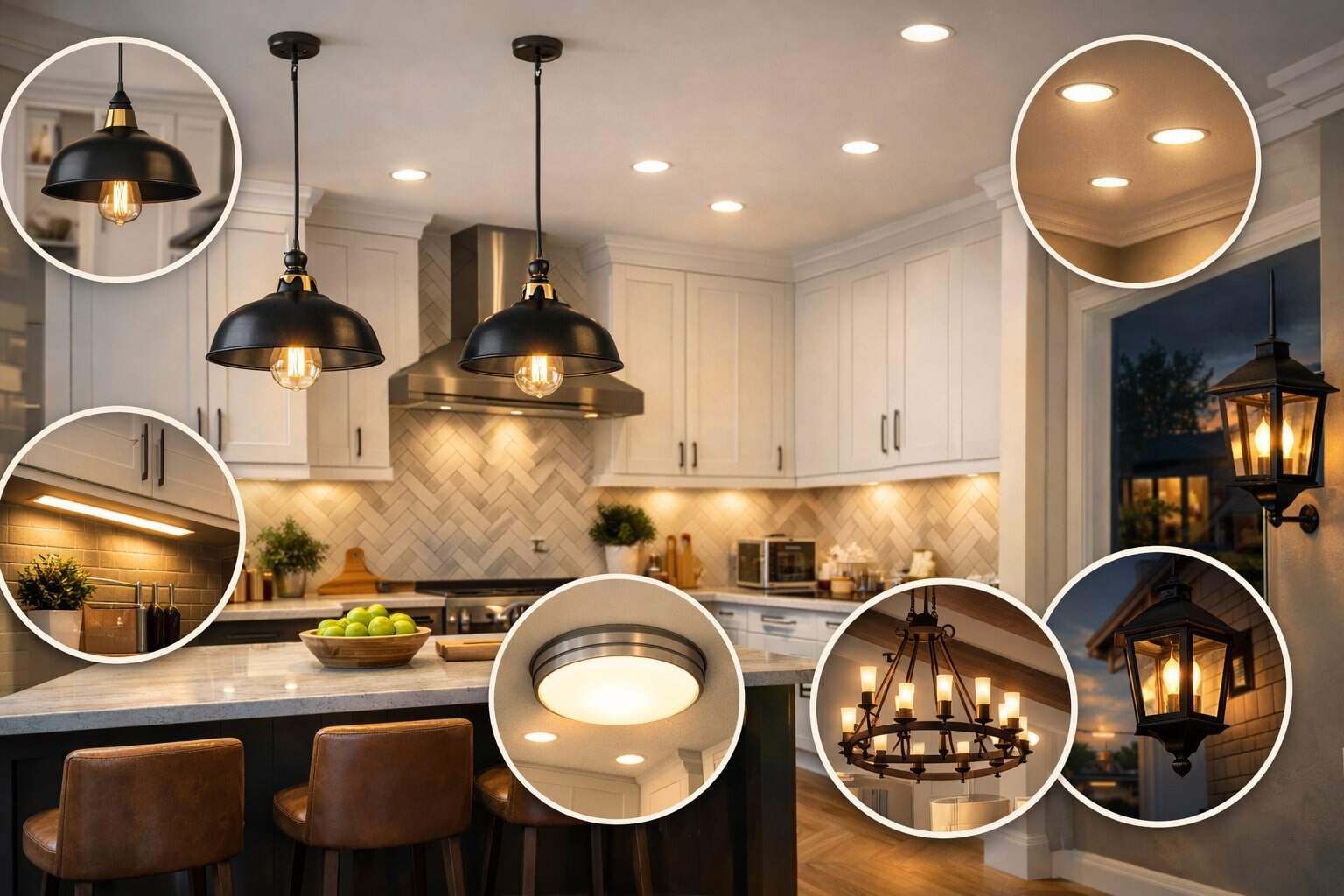
Great kitchen lighting is never “one fixture and done.” The best kitchen lighting ideas for Delaware homes layer multiple light types so your space works on dark winter afternoons, humid summer evenings, and everything in between.
Delaware’s mix of coastal cottages, suburban colonials, townhomes, and historic properties also means lighting plans have to flex: salt-air corrosion near the shore, lower ceilings in older homes, and open-concept living in newer builds all change what “good” looks like.
This guide walks through practical, design-forward kitchen lighting ideas for Delaware homes—from layout and fixture selection to energy code basics, rebates, smart controls, and future-ready upgrades.
The goal is simple: help you create a kitchen that feels bright and welcoming, supports safe cooking, and looks polished in photos and in real life. Along the way, you’ll see how to choose color temperature, avoid glare, light key work zones, and get the most from efficient LEDs while keeping the style authentic to your home.
Delaware homeowners also benefit from energy-efficiency programs and the state’s focus on modern energy codes and future “net zero capable” goals, which make efficient lighting and controls more relevant than ever.
Understand Layered Lighting: The Foundation of Every Great Kitchen
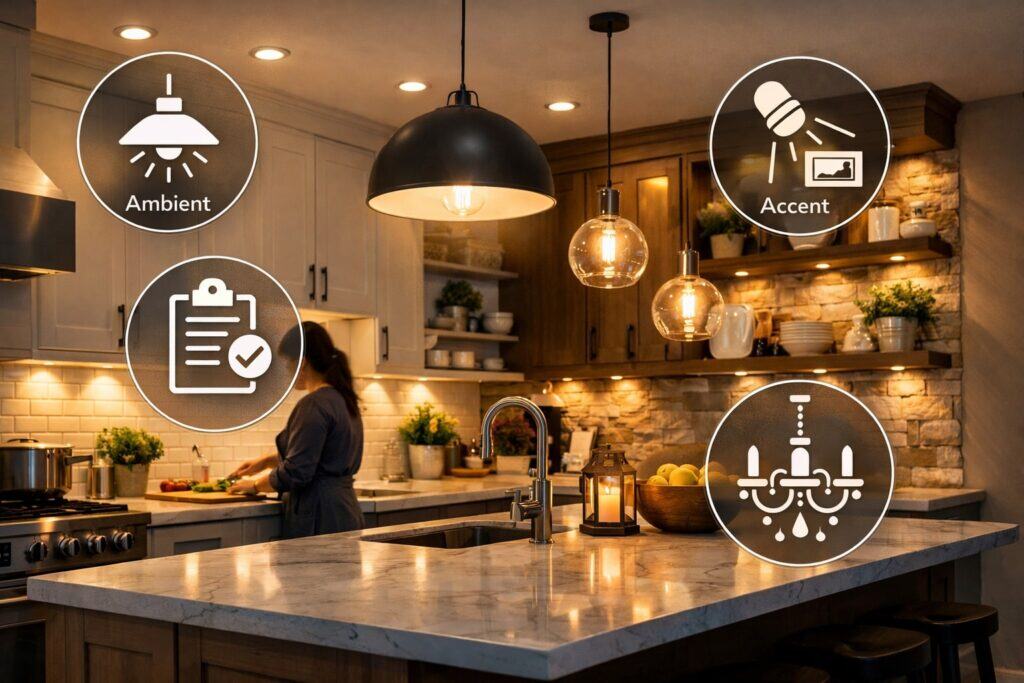
The most reliable kitchen lighting ideas for Delaware homes start with one concept: layering. Layered lighting means you combine ambient (overall), task (work), and accent (style) lighting so the kitchen performs well at any time of day.
If you rely only on a central ceiling light, shadows fall exactly where you prep food—right under your head and arms—making cutting, cooking, and cleaning harder than it should be. In Delaware winters, when daylight fades early, that problem becomes obvious fast.
Ambient lighting sets the baseline brightness. Think recessed lights, flush mounts, or well-placed semi-flush fixtures. Task lighting is what makes the kitchen function: under-cabinet LEDs on countertops, pendant lights over islands, and dedicated sink lighting.
Accent lighting adds depth and mood—like toe-kick lighting, interior cabinet lighting, or a statement fixture that becomes a focal point. The magic happens when these layers are on separate switches or dimmers, so you can raise light levels for cooking and lower them for dining, entertaining, or late-night snacking.
For Delaware homes, layering also helps you adapt to common architectural realities. Townhomes often have narrow kitchens that need careful spacing and glare control.
Older homes may have fewer ceiling boxes or limited wiring paths, making under-cabinet solutions even more important. Coastal properties often benefit from multiple smaller fixtures instead of one large fixture, reducing harsh contrasts and improving comfort.
If you remember only one takeaway, let it be this: the best kitchen lighting ideas for Delaware homes are designed around how you actually use the space—prep zones, sink, cooktop, island seating—then made beautiful with fixture style and warm, adjustable light.
Ambient Lighting Ideas That Make Delaware Kitchens Feel Bigger and Brighter

When people search kitchen lighting ideas for Delaware homes, they often start with ceiling lights—because that’s what you notice first. Ambient lighting is the “base coat” that keeps the room from feeling gloomy, especially in homes with smaller windows or north-facing kitchens. The key is even coverage without turning the ceiling into an airport runway.
Recessed lighting works well in many Delaware kitchens, but placement matters. A common mistake is placing cans in a single line down the center, which leaves countertops dim. Instead, position recessed fixtures closer to the countertop edges so light lands where you work.
In kitchens with lower ceilings (common in older properties), consider fewer recessed fixtures with higher-quality beams, or swap to slim, low-profile LED downlights that don’t feel intrusive.
Flush-mount and semi-flush fixtures are ideal for smaller kitchens and townhomes where headroom matters. Look for fixtures with diffusers to soften glare. If your kitchen ceiling is 8 feet, large chandeliers can feel overwhelming; semi-flush styles can add character while staying proportional.
In open-concept layouts (common in newer developments), ambient light should connect visually with living and dining zones, using consistent color temperature and finish choices.
Another smart approach for kitchen lighting ideas for Delaware homes is “ceiling bounce” light—fixtures or cove lighting that directs some light upward, reflecting off the ceiling to reduce harsh shadows. This can be especially helpful in winter months when you crave warmth and softness.
Efficiency matters too. Delaware’s building energy code framework and ongoing focus on modern standards make LED ambient lighting the default choice for long-term savings and better control.
Recessed Lighting Placement Tips for Townhomes and Older Delaware Layouts
Recessed lighting can be a game-changer, but only if it’s planned around real kitchen geometry. For many kitchen lighting ideas for Delaware homes, the biggest win is simply moving recessed lights to the right locations.
In narrow townhome kitchens, a single row down the middle creates shadowy countertops and a “tunnel” effect. Instead, aim for two rows aligned with the counter so the light falls in front of you, not behind you.
In older Delaware homes with lower ceilings, consider smaller aperture recessed lights (or slim wafer LEDs) that visually disappear. This keeps ceilings from feeling busy.
If your joists or framing limit placement, combine fewer recessed lights with under-cabinet lighting to guarantee task brightness where you need it. A thoughtful mix often looks cleaner than trying to force recessed lights everywhere.
Pay attention to beam angle and glare. If you stand at the sink and see the bare LED source, you’ll feel discomfort over time. Choose recessed trims designed to reduce glare, or aim for fixtures with deeper regress.
Also, separate your recessed lights into at least two zones—one for general circulation, one for work areas—so you can dim or brighten as needed. This zoning approach is one of the most practical kitchen lighting ideas for Delaware homes, because it adapts to everyday life: cooking, cleaning, entertaining, and quiet evenings.
Finally, match the color temperature across ceiling fixtures so your kitchen doesn’t look patchy—especially important in open layouts where the kitchen flows into adjacent rooms.
Flush, Semi-Flush, and Low-Profile Fixtures That Don’t Sacrifice Style
If your kitchen has limited ceiling height or you want a cleaner look, low-profile fixtures are some of the most underrated kitchen lighting ideas for Delaware homes.
Flush-mount ceiling lights can look modern and intentional—especially when you choose a fixture with a wide diffuser that spreads light evenly. Semi-flush fixtures sit slightly lower and add more visual interest without becoming a head-bump hazard.
For coastal Delaware homes, prioritize durable finishes. Humidity and salt air can accelerate wear, so powder-coated metals and high-quality plated finishes tend to hold up better than cheaper painted options.
In traditional homes, semi-flush fixtures with subtle detailing can echo classic architecture; in modern kitchens, minimalist discs or soft-drum shapes keep everything calm and cohesive.
A major advantage of these fixtures is comfort. Many low-profile lights provide soft, uniform illumination that reduces harsh ceiling hotspots. That makes your kitchen feel bigger and less cluttered—an effect homeowners often want when updating older properties or smaller townhome kitchens.
To keep your lighting plan future-friendly, choose fixtures rated for dimming and pair them with a compatible dimmer. Even if you never dim today, you’ll appreciate the flexibility later.
It’s a small upgrade that elevates many kitchen lighting ideas for Delaware homes from “fine” to “fantastic,” because mood control is what makes a kitchen feel like a home—not just a workspace.
Task Lighting Ideas: Safer Cooking, Better Prep, Less Eye Strain

Task lighting is where kitchen lighting ideas for Delaware homes stop being purely decorative and start making daily life easier.
If you cook regularly—or even just make coffee and pack lunches—task lighting is the difference between squinting at shadows and working comfortably. The goal is bright, focused light on the areas where you chop, measure, wash, and cook.
The most effective task lighting usually includes under-cabinet lighting for countertops, a dedicated light over the sink, and properly sized pendants or directional lighting over islands and peninsulas.
Under-cabinet LEDs reduce shadows because they shine directly onto the work surface. This is especially helpful in Delaware kitchens where daylight can be inconsistent throughout the year, and where trees, porches, or neighboring homes may limit natural light.
At the sink, task lighting improves safety and cleaning accuracy—whether you’re washing knives or prepping produce. Over the cooktop, thoughtful lighting helps you see food color and texture, which matters for timing and doneness. If you rely on a microwave hood light, you may still need additional light if the range area is wide or if you have a larger cooktop.
One of the best kitchen lighting ideas for Delaware homes is making task lighting independently controllable. That way, you can keep counters bright while dimming overhead lights during dinner. It also helps families: one person can prep while others relax nearby without the entire space being overly bright.
Energy efficiency also lines up well with task lighting. LEDs give you strong illumination with low heat output, which is a comfort benefit during humid summers.
Under-Cabinet Lighting: The Highest-Impact Upgrade Most Kitchens Need
If you want a “one upgrade that changes everything,” under-cabinet lighting is it. Among all kitchen lighting ideas for Delaware homes, this is often the most dramatic before-and-after improvement because it eliminates the most common kitchen shadow: your body blocking ceiling light from the counter.
Look for LED strips or bars that provide smooth, continuous light rather than dotted “hot spots.” Diffused channels help the light look high-end and reduce glare on glossy countertops.
For color temperature, many homeowners prefer a neutral-warm range that flatters wood tones and doesn’t feel clinical. If your kitchen is mostly white and modern, a slightly cooler neutral can look crisp—but avoid going too blue, especially if your adjacent living area uses warm light.
Installation details matter. Place under-cabinet lighting toward the front of the cabinet underside, not the back, so it illuminates the front edge of the counter and reduces glare in your eyes. If you have glass tile or shiny stone, use a diffuser and consider dimming so reflections don’t feel harsh at night.
For Delaware homes with older wiring, plug-in under-cabinet solutions can be a practical stepping stone, but hardwired systems look cleaner. Also consider adding lighting inside cabinets or pantry zones, especially if your kitchen has deep storage.
When done well, under-cabinet lighting becomes the “daily driver” of your lighting plan—used more than overhead lights. It’s a cornerstone of smart, modern kitchen lighting ideas for Delaware homes.
Island and Peninsula Lighting: Pendants, Mini-Chandeliers, and Glare Control
Islands are social hubs, so island lighting is where many kitchen lighting ideas for Delaware homes lean into personality. Pendants are popular because they define the space, provide task light, and add style.
The key is scale and comfort. Oversized pendants can look dramatic, but designers have been shifting toward more intentional sizing and layered lighting rather than “bigger is better.”
For an island, aim for fixtures that provide downward light without blasting glare into seated guests’ eyes. If your pendant has a clear glass shade, make sure the bulb isn’t painfully exposed—or choose a bulb designed to reduce glare. If your island is also a dining spot, consider pendants with softer diffusion or a shade that hides the bulb.
Spacing matters too. Multiple smaller pendants often look better than one giant fixture, especially in narrower Delaware townhome kitchens. If you have a wide island in a newer build, two or three pendants can balance the length. Choose a finish that ties into hardware or faucets, but don’t be afraid to mix metals for depth.
Mini-chandeliers can work well in traditional kitchens or beach-cottage styles, adding a decorative layer. Just make sure the fixture still supports task lighting needs—either via adequate lumen output or by pairing it with recessed lights and under-cabinet LEDs.
For future flexibility, put island lighting on a dimmer and consider smart bulbs or smart switches. That way your island can shift from bright prep mode to relaxed evening mode—one of the most livable kitchen lighting ideas for Delaware homes.
Accent Lighting Ideas: The “Designer” Layer That Adds Warmth and Value
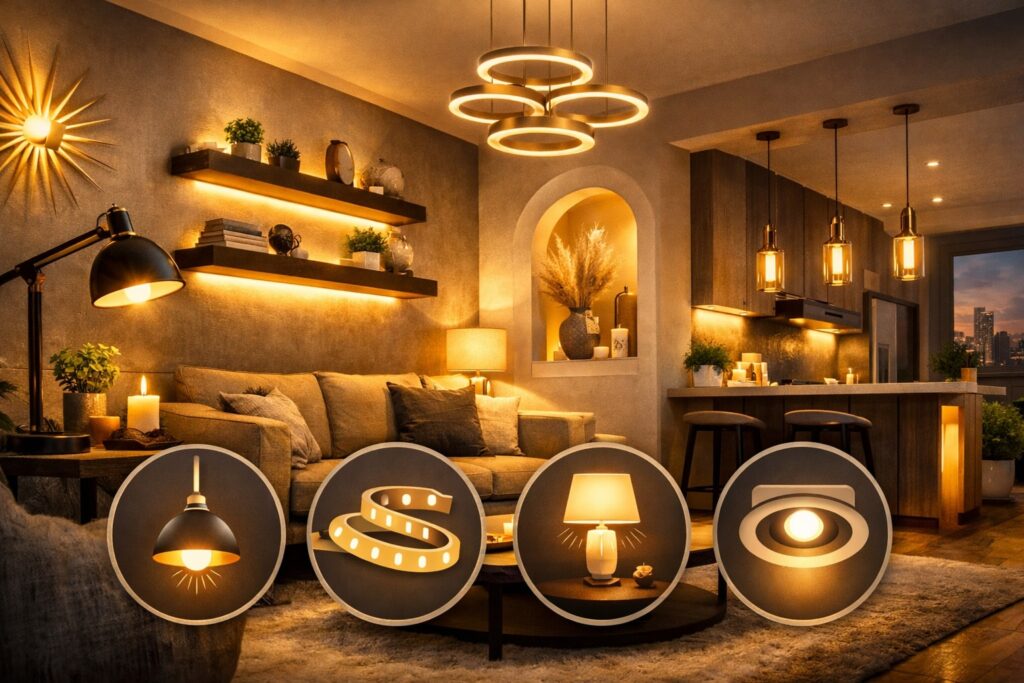
Accent lighting is the layer that makes your kitchen feel finished. Many homeowners exploring kitchen lighting ideas for Delaware homes focus on pendants and recessed lights, but accent lighting is what creates depth, highlights architectural features, and makes the room feel custom.
It also improves nighttime navigation—especially useful for families, older adults, or anyone who wants a safer path for late-night water runs.
Popular accent options include toe-kick lighting along base cabinets, lighting inside glass-front cabinets, and subtle lighting above cabinets or within open shelves.
These elements soften the room’s edges and reduce harsh contrast between bright counters and dark floors. In Delaware’s darker winter months, this warmth can make the kitchen feel significantly more comfortable and inviting.
Toe-kick lighting is one of the most practical accent features. It provides low-level illumination that helps you see the floor without turning on bright overhead lights. It’s also visually striking in modern kitchens, creating a floating cabinet look.
Inside-cabinet lighting, especially in pantries, helps you find items easily and reduces clutter because you can actually see what you have.
If your home has architectural features worth highlighting—like exposed beams, brick, or a beautiful hood surround—accent lighting can subtly draw attention without overpowering the space.
When designing accent lighting, keep controls simple. Group accent lighting together and put it on a dimmer. The goal is to make these lights easy to use so they become part of daily life, not a special-occasion feature. That usability is what turns accent features into truly great kitchen lighting ideas for Delaware homes.
Toe-Kick and Night Lighting for Safer Late-Night Navigation
Toe-kick lighting is an elegant solution to a very real problem: nighttime glare. If you flip on overhead kitchen lights at 2 a.m., your eyes get blasted and you feel wide awake.
Toe-kick lighting provides a gentle, low-level glow that guides your steps while keeping the mood calm. Among modern kitchen lighting ideas for Delaware homes, this is one of the most “small upgrade, big lifestyle payoff” choices.
For toe-kick lights, LED strips in aluminum channels are a common approach. They protect the strip, diffuse the light, and look clean. You can install them along the base of cabinets, under an island overhang, or even under floating shelves. If you have pets, toe-kick lighting also helps you avoid surprise obstacles.
Controls are where toe-kick lighting gets even better. Pair it with a motion sensor so it turns on automatically at night. Or connect it to a smart home routine that activates at sunset. For families, this reduces trips and falls. For entertaining, it adds a high-end feel that guests notice immediately.
In Delaware homes with open-concept layouts, toe-kick lighting also creates subtle separation between spaces—especially helpful when the kitchen opens into a living room. It becomes a soft visual boundary that makes the kitchen feel designed rather than purely utilitarian.
If you’re prioritizing comfort, safety, and atmosphere all at once, toe-kick lighting deserves a top spot on your list of kitchen lighting ideas for Delaware homes.
Glass-Front Cabinets, Pantry Lighting, and Showcase Shelving
If you have glass-front cabinets, open shelving, or a pantry that always feels like a black hole, internal lighting can transform both function and aesthetics. For homeowners seeking elevated kitchen lighting ideas for Delaware homes, this is how you get that “custom kitchen” look without rebuilding the entire room.
For glass-front cabinets, small puck lights or slim LED bars can highlight dishware and decorative items, adding depth at night. This works beautifully in traditional Delaware kitchens with classic cabinetry, and it’s equally effective in modern kitchens with sleek doors. If you’re concerned about heat, LED lighting is ideal because it runs cool and remains energy efficient.
Pantry lighting is about practicality. A bright, well-placed LED fixture—especially one with a motion sensor—makes it easier to stay organized. When you can see what you have, you waste less food and buy fewer duplicates. For deep or walk-in pantries, consider multiple light points instead of a single fixture at the entrance, so back shelves aren’t dim.
Showcase shelving lighting also supports modern trends toward layered, warm design. Designers continue to highlight layered lighting and softer ambiance as kitchens evolve beyond stark, overly bright spaces.
If you want your kitchen to feel welcoming and premium, internal cabinet and pantry lighting is one of the most convincing kitchen lighting ideas for Delaware homes—because it’s both useful and instantly noticeable.
Choosing the Right Color Temperature and Brightness for Delaware Kitchens
Many kitchen lighting ideas for Delaware homes look great in photos but feel wrong in real life because the light color is off. Color temperature (measured in Kelvin) determines whether the light feels warm, neutral, or cool.
Brightness (lumens) determines how well you can actually see. When these aren’t planned together, you get a kitchen that feels either dim and yellow—or bright but icy.
In kitchens, most homeowners prefer a warm-to-neutral white that flatters skin tones and food while still feeling clean. If you have warm wood cabinets, warmer light enhances richness and comfort.
If your kitchen is contemporary with cool finishes, a neutral light can keep everything crisp. The bigger issue is consistency: mixing multiple bulbs with different color temperatures can make the kitchen feel patchy.
Brightness depends on your layout and surfaces. Dark countertops and matte finishes absorb light, so you often need more lumens. White cabinets, glossy tile, and reflective stone bounce light, so you can use slightly lower output while still feeling bright.
That’s why the best kitchen lighting ideas for Delaware homes don’t chase a single “perfect” bulb—they calibrate brightness by zone.
Also consider seasonal comfort. Delaware winters can make homes feel darker and cooler. Lighting that’s too cool can amplify that “cold” feeling. Many homeowners prefer warmer light in the evening to help the kitchen feel cozy and relaxing.
A modern solution is tunable lighting: bulbs or fixtures that can shift color temperature. You can keep a neutral tone during daytime cooking and shift warmer at night for ambiance. That flexibility is increasingly common in current lighting trends and smart home upgrades.
Warm vs. Neutral White: Matching Light to Cabinets, Counters, and Mood
When selecting kitchen lighting ideas for Delaware homes, think of color temperature as part of your material palette—like cabinet stain or hardware finish. Warm white light tends to complement traditional kitchens, warm woods, and cozy cottage styles. Neutral white works well in transitional designs and helps colors look accurate when cooking.
If your kitchen has white cabinets and you want it to feel inviting rather than sterile, consider leaning warm-to-neutral and using layered accent lighting to add softness. If you have a lot of gray or cool-toned finishes, neutral white can prevent the space from looking muddy.
The most important practical rule: keep your main light sources aligned. If your recessed lights are neutral but your pendants are warm, you’ll notice the mismatch immediately. Instead, aim for one consistent base tone across overhead and task lighting, then let accent lighting add warmth.
This is also where dimming becomes essential. A dimmed warm light at night feels completely different from full-brightness task lighting. Dimmers let you adjust mood without changing fixtures. For homeowners building out kitchen lighting ideas for Delaware homes, this is one of the simplest ways to make lighting feel “luxury” without overspending.
If you want the best of both worlds, tunable-white LEDs let you shift the kitchen’s vibe across the day. That’s a future-friendly approach that aligns with where kitchen lighting is headed.
How Many Lumens Do You Need? A Practical, Zone-Based Approach
A lot of frustration with kitchen lighting ideas for Delaware homes comes from guessing brightness. Instead of trying to pick one “bright enough” fixture, think in zones:
- Overall ambient light should make the room feel evenly lit and comfortable.
- The countertop task light should be bright enough for chopping and reading recipes.
- Island lighting should support prep and seating without glare.
- Accent lighting should be softer and mostly decorative.
If your kitchen feels dark even with good ceiling fixtures, the missing piece is often countertop lighting. Under-cabinet LEDs can do heavy lifting because they deliver light exactly where you need it. Over an island, multiple smaller fixtures often provide better coverage than one central pendant.
Reflective materials can reduce the brightness you need, while darker countertops require more. Also consider ceiling height: taller ceilings spread light out more, so the same fixture may feel dimmer in a room with more volume.
The “right” answer is the one that fits your life. If your kitchen is a high-use cooking space, err brighter in task zones. If it’s more for light meals and entertaining, prioritize dimming and warm layers so the space feels welcoming.
This zone-based thinking is one of the most practical kitchen lighting ideas for Delaware homes because it prevents over-lighting (harsh, glaring kitchens) and under-lighting (shadowy counters and eye strain).
Energy Efficiency, Rebates, and Code Considerations for Delaware Homeowners
Energy efficiency isn’t just an environmental talking point—it’s central to smart kitchen lighting ideas for Delaware homes. LEDs reduce energy use, last longer, and produce less heat, which is a comfort benefit in humid months. Delaware also points homeowners toward modern energy codes and programs that encourage efficient upgrades.
Delaware’s building energy code information is maintained through state resources, and enforcement can vary by county or municipality, so homeowners doing renovations should confirm local requirements. The state has adopted versions of national energy standards for certain building categories, and energy efficiency remains a policy priority.
On the incentive side, Energize Delaware offers residential grants and rebates that can reduce the cost of energy-efficient upgrades. While these programs may not always be “lighting-only,” lighting often fits into broader home performance improvements and efficiency projects.
There are also federal-state coordinated rebate efforts designed to help reduce home energy costs, expected to roll out as funding and implementation proceed. These programs generally focus on whole-home efficiency and electrification improvements, but efficient lighting and controls can complement those upgrades.
Finally, Delaware has long-term policy goals around “net zero capable” new construction targets, which makes efficient lighting and smart controls more relevant over time.
LED Upgrades, Controls, and What to Ask Your Electrician
When you talk to an electrician about kitchen lighting ideas for Delaware homes, you’ll get better results if you ask specific questions—not just “Can you add lights?” Start with LED quality and compatibility:
- Are the fixtures dimmable, and which dimmers are compatible?
- Will the light be flicker-free at low dim levels?
- Is the color temperature consistent across brands and fixture types?
- Are the fixtures rated for damp locations if they’re near sinks or moisture-prone areas?
Controls matter more than many homeowners realize. Modern energy codes often emphasize efficient lighting and controls like dimmers or sensors in many contexts, and the market is clearly moving toward smarter, more controllable kitchens.
Also ask about wiring strategy. If you’re opening walls during a remodel, it’s the best time to add dedicated circuits or runs for under-cabinet lighting and island lighting. If you’re not opening walls, look for creative solutions like surface raceways or high-quality plug-in systems (with clean cable management) as transitional steps.
For coastal areas, consider corrosion resistance and sealed components. This is a practical Delaware-specific detail that protects your investment long-term.
The best result is a plan where each lighting layer has its own control: overhead ambient, under-cabinet task, island pendants, and accent lights. That is the “pro” version of kitchen lighting ideas for Delaware homes, and it’s what makes your kitchen adaptable for years.
Rebates and Programs That May Support Efficiency-Focused Kitchen Lighting Projects
If you’re investing in kitchen lighting ideas for Delaware homes, it’s worth checking incentive programs before you buy fixtures. Energize Delaware provides a central place to review residential grants, rebates, and assistance programs that support energy-efficient upgrades.
In many cases, the biggest savings come from bundling improvements—like pairing lighting upgrades with a home performance assessment, insulation improvements, or HVAC efficiency work.
Program flyers and materials often highlight how contractors recommend eligible measures after an assessment, which can help you prioritize upgrades with the best ROI.
Delaware also has information on home energy rebate programs tied to broader efficiency and electrification efforts, expected to launch as implementation proceeds. While these are not always “lighting rebates” specifically, efficient lighting and controls typically complement the same goals: reducing energy waste and improving home comfort.
Because program details can change, focus on this approach:
- Confirm eligibility and approved contractors (if required).
- Keep receipts and product specs.
- Plan your lighting upgrade as part of a larger efficiency story (LED + controls + better layout).
This strategy supports long-term value and helps your kitchen lighting ideas for Delaware homes pay off financially as well as aesthetically.
2025–2026 Kitchen Lighting Trends and How to Use Them Without Regret
Trends can inspire great kitchen lighting ideas for Delaware homes, but the goal is timeless function with trend accents—not a kitchen that feels dated in two years. Current kitchen lighting trends emphasize bold but intentional layering, statement pendants, mixed finishes, and warmer, more lived-in ambiance rather than sterile brightness.
One trend that fits Delaware especially well is warm minimalism—a style that blends simple forms with cozy materials and soft lighting. It works in beach-adjacent homes because it complements natural textures like wood, linen, and stone. It also suits townhomes where visual calm makes spaces feel larger.
Designers are also moving away from extremes—like oversized pendants that dominate the space—and leaning into lighting that supports both style and real-life usability.
Another major trend is smart lighting and tunable white, allowing homeowners to shift brightness and color tone depending on time of day and activity. This isn’t just a gadget trend—it’s a lifestyle improvement, especially in kitchens that serve multiple roles: cooking, homework, working from home, entertaining.
If you love a trend, apply it where it’s easiest to update later: pendants, decorative fixtures, and accent lighting. Keep your core infrastructure—under-cabinet lighting, recessed placement, switching—focused on timeless performance. That balance is the safest way to use trends within kitchen lighting ideas for Delaware homes.
Statement Pendants, Mixed Metals, and “Warm Minimalism” in Real Kitchens
Statement pendants are still popular, but the modern version is more refined: fixtures that feel sculptural without overpowering the room.
For kitchen lighting ideas for Delaware homes, this works best when pendants echo your home’s architecture. A coastal cottage might look great with woven or textured shades, while a classic colonial kitchen may suit traditional lantern shapes or soft-glass forms.
Mixed metals are another trend that’s surprisingly timeless when done thoughtfully. You don’t have to match everything perfectly. Instead, repeat finishes with intention: maybe the faucet matches cabinet hardware, while pendants introduce a secondary metal tone that shows up again in barstools or décor.
Warm minimalism is less about “bare” spaces and more about calm, comfortable simplicity. Lighting plays a huge role here. Softer diffusion, warmer tones in the evening, and a focus on layered light rather than maximum brightness creates that lived-in feel designers are leaning toward heading into 2026.
If you’re unsure what will age well, choose pendants with classic shapes and high-quality materials, then update bulbs and controls over time. That approach supports long-lasting kitchen lighting ideas for Delaware homes without locking you into a short-lived look.
Smart Lighting, Tunable White, and the Rise of Circadian-Friendly Kitchens
Smart lighting is becoming one of the most practical kitchen lighting ideas for Delaware homes, especially as kitchens become multi-use spaces. Smart switches and bulbs can schedule lighting changes automatically—brighter and more neutral during morning routines, warmer and dimmer at night for relaxation.
Tunable-white lighting is a standout upgrade because it addresses two common issues at once: color temperature preferences and time-of-day comfort. If your household disagrees about “warm vs. cool,” tunable-white ends the debate. It can also reduce the harshness of bright white light at night, which many people find disruptive.
From a future perspective, “circadian-friendly” lighting—light that shifts warmer in the evening and cooler during the day—will likely become more mainstream as more homeowners adopt smart home ecosystems. Trends coverage continues to highlight smart lighting as a core direction in kitchen design.
If you want to future-proof, prioritize smart controls first (smart dimmers/switches) and keep fixtures high quality. Controls can evolve over time without replacing your entire lighting system. This is a practical, scalable way to implement smart-forward kitchen lighting ideas for Delaware homes.
Future Predictions: Where Kitchen Lighting Is Headed in Delaware Homes
The future of kitchen lighting ideas for Delaware homes is heading toward three big themes: efficiency, control, and integration. Efficiency will continue to matter as energy costs fluctuate and as policy goals push toward higher-performance homes.
Delaware has long-term net-zero-capable goals for new construction, which reinforces the direction of travel: efficient lighting, smart controls, and systems that support broader energy strategies.
Control is the next frontier. Kitchens are already moving toward more layered lighting and more user-friendly control. Expect more homes to adopt scenes like “Cook,” “Clean,” “Dinner,” and “Night,” triggered by smart switches, voice assistants, or schedules.
This doesn’t just feel cool—it reduces energy waste because you use the right lights at the right levels instead of blasting everything on.
Integration means lighting will increasingly coordinate with ventilation, appliances, and even safety features. For example, task lighting that automatically brightens when the cooktop turns on, or toe-kick lighting that activates as a nighttime pathway.
As smart home standards mature, compatibility should improve and reduce the frustration people sometimes experience with early smart devices.
There’s also a style prediction: continued movement toward warmth. Many trend sources show kitchens becoming less sterile and more layered, with softer lighting and natural textures.
If you’re remodeling now, the most future-proof plan is still classic: strong under-cabinet task lighting, dimmable ambient lighting, thoughtful accent lighting, and flexible controls. Those fundamentals keep your kitchen lighting ideas for Delaware homes relevant even as tech changes.
FAQs
Q.1: What are the best kitchen lighting ideas for Delaware homes if I can only make one upgrade?
Answer: If you can only do one upgrade, prioritize under-cabinet lighting. It improves safety, reduces shadows, makes countertops more usable, and instantly modernizes the kitchen. For many homeowners, it becomes the most-used lighting layer.
It also pairs well with future upgrades like smart dimmers and accent lighting, making it one of the most scalable kitchen lighting ideas for Delaware homes.
Q.2: How do I stop glare on glossy countertops and shiny backsplashes?
Answer: Glare is usually caused by exposed bulbs, overly bright point sources, or poorly diffused LEDs. Use diffusers on LED strips, choose fixtures that shield the light source, and put task lighting on dimmers.
Position under-cabinet lights toward the front of the cabinet underside to light the counter evenly without reflecting directly into your eyes. These adjustments make kitchen lighting ideas for Delaware homes feel comfortable instead of harsh.
Q.3: Are pendant lights enough for an island, or do I still need recessed lighting?
Answer: In most cases, pendants alone aren’t enough for perfect coverage—especially if you use the island for cooking and prep. A better approach is pendants for style + focused light, paired with recessed ambient lighting and under-cabinet task lighting for the rest of the kitchen.
This layered plan is the most reliable version of kitchen lighting ideas for Delaware homes, because it works for both entertaining and everyday cooking.
Q.4: Do I need smart lighting, or is it optional?
Answer: Smart lighting is optional, but smart controls can be a high-value upgrade. Even a single smart dimmer that runs scheduled scenes can make your kitchen feel more comfortable and reduce energy use.
Trends continue to point toward smart lighting becoming more standard in modern kitchens. If you’re unsure, start with dimmers and good LED fixtures—then add smart features later.
Q.5: Are there Delaware programs that support energy-efficient upgrades tied to lighting?
Answer: Energize Delaware provides a central hub for residential grants and rebates that support energy-efficient improvements, and some upgrades may fit into broader home performance projects.
Delaware also shares information about home energy rebate programs designed to reduce energy costs as implementation proceeds. Because programs change, check current requirements before purchase and installation.
Conclusion
The most successful kitchen lighting ideas for Delaware homes don’t rely on one “perfect” fixture. They combine layered lighting—ambient, task, and accent—so your kitchen works on bright summer mornings and dark winter evenings.
Start with fundamentals: even ambient light, strong under-cabinet task lighting, and island/sink lighting that reduces shadows. Then add accent lighting for warmth, safety, and that custom, high-end feel.
From there, refine the details: consistent color temperature, glare control, dimmers, and durable finishes that make sense for Delaware conditions, especially in coastal areas. Finally, consider future-proofing with smart controls and tunable lighting so your kitchen can shift from work mode to relaxation mode instantly.
Delaware’s emphasis on modern energy priorities and long-term goals like net-zero-capable new construction reinforces the direction many homeowners are already taking: efficient LEDs, better controls, and lighting plans designed around real life.